

Quick Answer
The Short Answer
An ESOP and a third-party sale are fundamentally different transactions with different tax outcomes, timelines, and implications for employees. ESOPs often produce superior after-tax results, particularly for C-corporation owners using the Section 1042 capital gains rollover, or S-corporation owners whose company would pay zero federal income tax under 100% ESOP ownership. Third-party strategic buyers typically offer higher headline prices, but those proceeds face capital gains taxes of 23 to 30% or more at closing. The right choice depends on your specific tax structure, cost basis, and what you want the exit to accomplish beyond the check.
When business owners run the after-tax comparison honestly, ESOPs win more often than most people expect. A 100% S-corporation ESOP pays zero federal income tax on profits, a structural advantage that doesn't exist anywhere else in the tax code. A C-corporation seller using the Section 1042 rollover can defer capital gains taxes on the full sale proceeds indefinitely, meaning an ESOP deal priced at 85 to 90 cents on the dollar relative to a strategic buyer's offer can net more after taxes than the higher headline price, once combined federal and state capital gains rates of 25 to 30% are applied to the third-party proceeds.
Questions this article answers
- Does an ESOP or a third-party sale typically result in more money after taxes?
- What are the real risks of selling to private equity versus selling to employees through an ESOP?
- How do I know if my business qualifies for the ESOP tax advantages, including the Section 1042 rollover?
Quick Answer
Most business owners I talk to assume that an exit means finding a buyer, negotiating a price, and handing over the keys. What they're less familiar with is the fact that there are two genuinely different kinds of "buyer", and the choice between them can determine whether you keep three-quarters of your proceeds or closer to half. That is a significant difference, and it deserves more than a passing conversation with your accountant in the year you decide you're ready to sell.
I've worked with enough owners through exit transitions to know that the tax math alone doesn't tell the whole story, but it's usually the best place to start. This piece lays out both paths honestly. An ESOP and a third-party sale are not interchangeable options with minor variations. They are structurally different transactions with different tax outcomes, different timelines, different risks, and different implications for the people you built the business with. My job here is to explain how each one actually works, and help you figure out which questions to ask before you decide.
What Is an ESOP and How Does a Sale to One Actually Work?
An ESOP, an Employee Stock Ownership Plan, is a qualified retirement plan that holds company stock on behalf of employees. That's the technical description. What it means in practice is that your employees become the owners, not through some feel-good gesture but through a formal, federally regulated structure that transfers real equity to a trust on their behalf, which then allocates shares to employee accounts over time as a retirement benefit.
Here is how the mechanics work. You decide to sell some or all of your business to the ESOP trust. The trust buys your shares using one of two funding sources: cash the company has on hand, or borrowed money, a bank loan guaranteed by the company itself. In a leveraged ESOP, the most common structure, the company takes on debt to finance the purchase of your shares and then repays that debt over time using its pre-tax profits. As the debt is paid down, shares are released into employee retirement accounts. An independent trustee oversees the entire plan on behalf of the employees and is legally required to ensure the purchase price reflects fair market value as determined by an independent appraiser. The Department of Labor takes this requirement seriously: more seriously than you might expect, and the paperwork reflects it, as of .
The sale can be partial or complete. Some owners sell 30% to the ESOP initially, take some cash off the table, and complete the rest later. Others do a full 100% sale in one transaction. The percentage matters: particularly for the tax benefits, which I'll explain shortly.
The numbers behind ESOPs are larger than most people expect. The National Center for Employee Ownership estimates that more than 6,400 ESOP plans exist today, covering roughly 14 million employee-owners and controlling over $1.4 trillion in plan assets. Approximately 97% of ESOPs are established for privately held companies, so this is not a structure invented for publicly traded behemoths. It was designed for businesses exactly like yours.
What Is a Third-Party Sale and Who Is Typically Buying?
A third-party sale is what most owners picture when they say "exit." You hire an investment banker, run a competitive process, and sell to the highest bidder. The buyer might be a strategic acquirer: a larger company in your industry looking for your customers, your team, or a foothold in your market. It might be a private equity firm looking to acquire a platform business or add you as a bolt-on to a company they already own. It might be a competitor, a family office, or a regional consolidator rolling up similar businesses.
The process follows a fairly standard arc. Your investment banker prepares a confidential information memorandum, essentially a very polished sales document, and contacts a curated list of potential buyers. Interested parties sign NDAs, review the materials, and submit indications of interest. You narrow the field, run management presentations, and eventually enter exclusivity with the strongest candidate to complete due diligence and close. From first meeting with the banker to cash in the bank, plan on nine to eighteen months at minimum.
The buyers most business owners encounter in the current market are often private equity-backed. PE firms globally hold over $1 trillion in uncommitted capital, and a substantial portion is actively seeking profitable, well-run businesses in the $5M-$50M revenue range. That demand creates real competition, which benefits sellers. Strategic buyers still pay meaningful premiums when genuine synergy is on the table, but financial buyers have closed the gap considerably in recent years.
The fundamental difference from an ESOP is control. In a third-party sale, you are transferring ownership: and with it, direction: to a party who has their own agenda, their own cost structure, and their own timeline. That's not inherently a problem. Some buyers are exceptional operators who grow businesses dramatically. But as succession planning practitioners have noted, "when companies go to a third-party sale, a lot of times the culture from the old company doesn't transition through", and the resulting disconnection can affect the business long after you've left. That is the honest reality of what a third-party exit looks like.
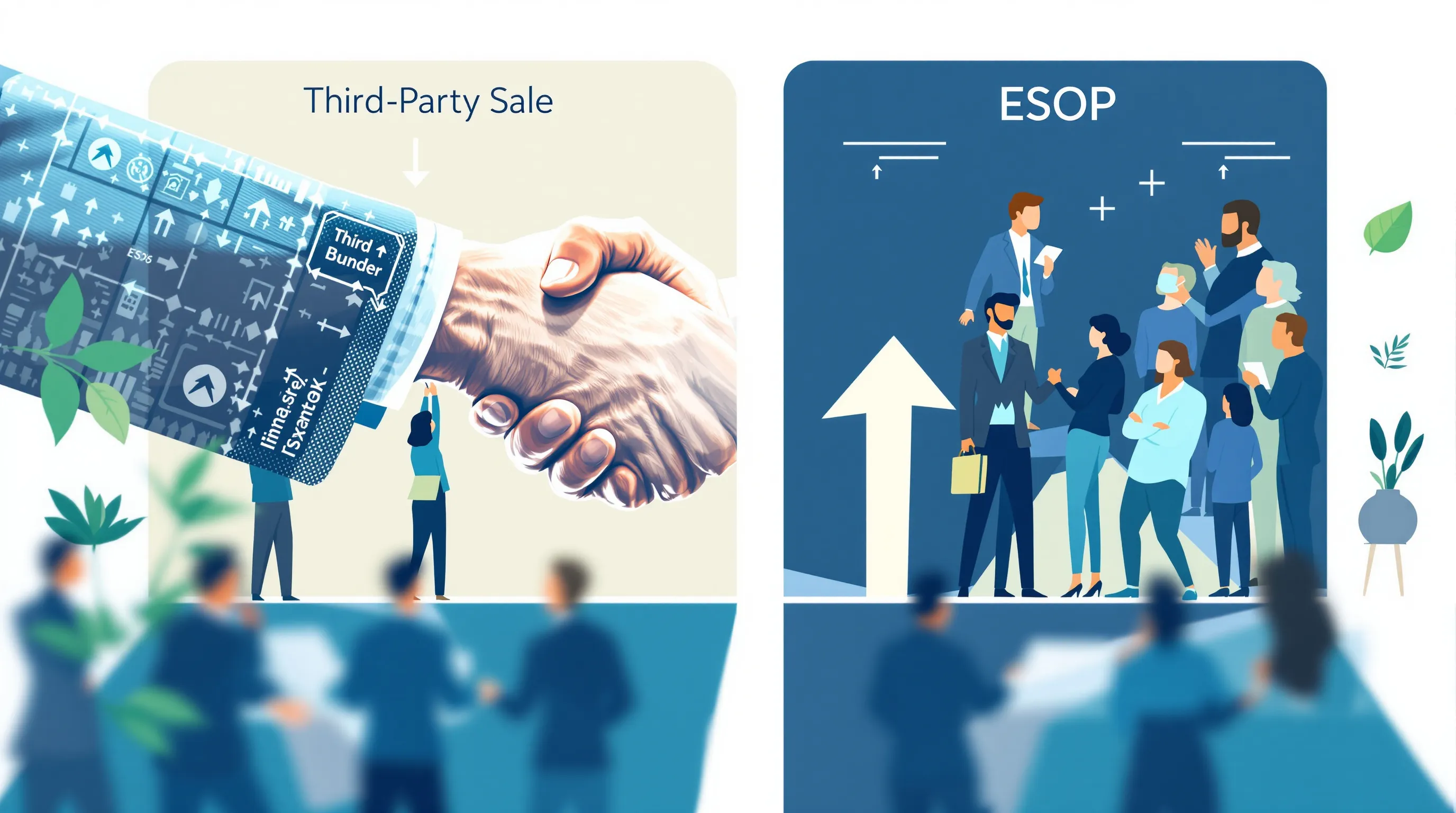
How Do the Tax Implications Actually Compare?
This is where ESOPs can become genuinely compelling, and where most business owners realize they've been asking the wrong question. The question isn't just "which path pays more?" The right question is "which path leaves more in my pocket after taxes?" Those two answers can be very different, and the gap depends almost entirely on how your business is structured and how you handle the proceeds.
If you own a C-corporation and sell to an ESOP that acquires at least 30% of your company, Section 1042 of the Internal Revenue Code allows you to defer capital gains taxes on the sale proceeds, potentially indefinitely. To qualify, you must reinvest the proceeds into Qualified Replacement Property (QRP): stocks or bonds of domestic operating corporations, typically diversified publicly traded securities. You have twelve months after the sale to make that reinvestment. If you hold those replacement securities until death, your heirs receive a stepped-up basis, and the deferred gains may never be subject to federal income tax. For a business owner with a low basis, meaning you built this thing from the ground up. That is a substantial advantage. As Will Stewart of PCE Investment Bankers explains it: "A sale to an ESOP guarantees a stock sale, which is already an advantage to the seller. It also potentially allows the seller to defer or avoid all capital gains taxes on the sale of their business. This tax advantage is unique to ESOPs."
For S-corporation ESOPs, the benefit operates differently but can be even more dramatic at the company level. A 100% employee-owned S-corporation pays zero federal income tax on its profits. The S-corp structure means profits pass through to shareholders: but since the ESOP trust is a tax-exempt entity, there is no taxable shareholder to receive them. Every dollar of operating profit that would otherwise be taxed is instead available to pay down the debt used to finance the ESOP purchase. That accelerates debt repayment, which releases shares to employee accounts faster. As ESOP advocate Darren Gleeman of MBO Ventures describes it: "An owner can sell the company to the employees, defer their capital gains taxes on the sale, the IRS subsidizes the entire buyout, and the company runs completely tax free." That's a remarkable structural advantage, and one that doesn't exist anywhere else in the tax code.
Now compare that to a third-party sale. When you sell to a strategic buyer or private equity firm, the proceeds are typically taxed as long-term capital gains in the year of the transaction. Federal long-term capital gains rates run up to 20%, and the net investment income tax adds another 3.8% on top for high earners, bringing the combined federal rate to 23.8%. Add your state's capital gains tax, and a $10 million sale can easily generate a $3 to $4 million tax bill due within twelve months of closing.
Installment sales and earnout structures can spread the tax hit over multiple years, but they don't eliminate it, and they introduce their own complications that I'll cover when we get to risks.
Which Exit Path Typically Pays More After Taxes?
The honest answer is: it depends, and anyone who gives you a quick answer without running the actual numbers for your situation is guessing. But the framework for thinking through it is straightforward.
Strategic buyers routinely pay more than ESOP valuations at the headline level. A competitor who genuinely wants your customer relationships and market position might pay seven to nine times EBITDA. An ESOP, which is required by law to pay no more than fair market value as determined by an independent appraisal, typically comes in at five to seven times EBITDA. Business owners who have explored both paths report that ESOP valuations commonly land at 80 to 95% of what a competitive third-party process would yield: a real gap, but one that may not survive contact with the tax math.
Run the after-tax comparison for a C-corporation owner with a low tax basis. A strategic buyer offers $11 million. After federal capital gains tax at 23.8% and a 5% state tax, the net proceeds are roughly $7.8 million: a substantial check, due within months of closing. An ESOP comes in at $9 million, lower headline, but with a Section 1042 rollover, the owner defers the entire capital gain and has $9 million in Qualified Replacement Property invested in diversified securities. The ESOP deal leaves more money working for the owner, despite a lower purchase price.
The math doesn't always work this way. For owners with a high basis, minimal built-in gains, or business structures that don't qualify for Section 1042, a third-party premium may well win on an after-tax basis. There is no universal answer: which is exactly why this comparison requires actual numbers, not rules of thumb.
What Happens to Your Employees and Company Culture?
This is the question many business owners feel awkward asking out loud, as if caring about their people somehow makes them less serious about maximizing value. In my experience, it's one of the most legitimate inputs in the decision. The people who helped you build the business will still be there long after you leave, and what happens to them is a real outcome, not a sentimental footnote.
ESOPs, by design, make employees the owners. Over time, shares accumulate in their retirement accounts as a direct benefit, funded entirely by the company. As Darren Gleeman of MBO Ventures describes it: "It costs the employees absolutely nothing. It's a gift from you and from the IRS." And the business results tend to follow. ESOP companies have a retention rate approximately 300% greater than comparable non-ESOP companies. Ownership creates a different kind of engagement than employment: not universally, not automatically, but often enough to show up in the data repeatedly across different industries and company sizes.
Third-party sales present a more variable picture. A strategic buyer integrating your company into a larger organization will have its own culture, its own org chart, and its own ideas about where your people fit. Some of that can be genuinely good: better benefits, clearer career paths, more resources. Some of it is consolidation: duplicate roles eliminated, reporting structures changed, and cultural norms replaced with the acquirer's. Private equity acquisitions often involve an explicit plan to reduce overhead costs, and that phrase means what you think it means.
One data point worth keeping in mind: research cited across exit planning circles consistently shows that as many as 75% of business owners report regretting their exit within a year of closing. I'm not suggesting an ESOP prevents regret. But owners who chose an ESOP for legacy and cultural reasons, who knew their employees would become the owners, tend to have different outcomes on that dimension than those who optimized solely for headline price.
How Long Does Each Process Actually Take?
Neither path is fast. That's worth knowing upfront, because business owners often start these conversations with timelines that bear no relationship to how these transactions actually unfold.
A third-party sale, from engaging an investment banker to the day of closing, typically runs nine to eighteen months under favorable conditions. Larger or more complex businesses routinely take longer. Due diligence can surface issues that extend the timeline or reset the deal entirely. Plan for twelve months as a realistic baseline and add a buffer.
An ESOP transaction, from initial feasibility study to close, typically takes twelve to twenty-four months. The plan requires an independent business valuation, legal documentation for both the plan and the trust, financing arrangements, DOL compliance review, and ongoing plan administration setup. None of that moves quickly. The upside is that the process is more within your control: there's no outside bidder who can change their mind at the last minute, and the transaction doesn't fall apart the way a competitive sale can when a buyer gets cold feet in diligence.
What Are the Real Risks of Each Path?
Both paths carry risks that don't get enough airtime during the excitement of evaluating an exit. Here is my honest summary of the ones that matter most in practice.
For an ESOP, the primary operational risk is debt. If the company takes on significant leverage to finance the purchase of your shares, it needs to generate consistent cash flow to service that obligation. A revenue decline, a key customer departure, or an economic disruption during the repayment period can put real strain on the business, strain that the employee-owners will ultimately absorb. Additionally, the DOL and IRS take ESOP compliance seriously. Typical ESOP setup costs run $300,000 to $400,000, plus roughly $100,000 per year in ongoing legal and governance compliance. Ongoing plan administration: trustee fees, annual valuations, legal, adds another $50,000 to $150,000 annually. The general rule of thumb in the ESOP advisory community is that a business needs at least $1 million in annual EBITDA to justify the structure.
For a third-party sale, the most underappreciated risk I see in practice is the earnout. PE deals commonly structure 15 to 30% of the total deal value as contingent payments tied to future performance targets. You're betting that portion of your proceeds on hitting metrics under new ownership, with a new cost structure and new priorities you didn't choose. Earnouts that sound reasonable at signing deliver less than expected more often than not. That's not cynicism, it's a pattern worth taking seriously before you sign the LOI.
How Do You Know Which Path Is Right for You?
After working through this decision with business owners over the years, I've found that four questions do most of the sorting work.
First: what is your business's tax structure, and what is your cost basis? The ESOP tax advantages, particularly Section 1042 and the S-corp income tax exemption, are powerful but not universal. A high-basis business or a structure that doesn't qualify for 1042 changes the math substantially.
Second: how important is price certainty to you? ESOPs offer more predictable deal terms but typically lower headline values. Third-party processes can yield higher prices but involve more uncertainty, longer diligence periods, and conditions that can shift late in the process.
Third: what do you want the next chapter to look like for your people? If cultural continuity and employee security matter to you, that's a real input, not a soft one.
Fourth: how long are you willing to remain involved post-close? Many PE transactions require the seller to stay in a leadership role for one to three years. If you want a clean exit on a defined timeline, that constraint matters. ESOPs often benefit from a transition period too, but the terms tend to be more flexible.
There isn't a right answer that applies to every situation. Which is, of course, the point.
What Will Matter Most in the Next 12 to 24 Months?
If you're considering an exit in the next one to two years, a few forces are reshaping the comparison between ESOPs and third-party sales in ways that are worth understanding before you commit to a path.
The private equity market has recalibrated after the aggressive deal-making pace of the early 2020s. Rising interest rates made leveraged buyouts more expensive and compressed PE multiples in many sectors. Strategic buyers with strong balance sheets have picked up some of that slack, but the gap between "what PE is paying" and "what a strategic acquirer will pay" has widened in certain industries. If your mental model of PE multiples is based on what you heard about in 2021 or 2022, a current-market conversation with an investment banker should recalibrate those expectations before you decide whether a competitive process is likely to yield the number you need.
On the ESOP side, the legislative environment has remained favorable. The tax advantages that make ESOPs compelling, Section 1042 for C-corporation sellers, the S-corporation income tax exemption for 100% ESOP-owned companies, have not been substantially altered in recent years. Tax policy is always subject to change, and business owners considering an ESOP sometimes ask whether these provisions might be modified in future legislation. As of mid-2026, there are no imminent changes on the horizon. But this is a reason to act on clear tax advantages when they exist rather than assume they will persist indefinitely, tax law is not a permanent feature of the landscape.
The employee retention environment also affects this comparison. Businesses that have struggled to retain skilled employees, a persistent challenge across many sectors following the pandemic-era workforce disruptions, may find the ESOP ownership model particularly compelling as a differentiated retention tool. An ownership stake creates a different kind of financial alignment than a bonus or a raise. It builds over time and can reduce turnover in ways that salary adjustments alone cannot match. If you're spending significant money on recruiting to replace departing employees, that cost should factor into your thinking about which exit structure best positions the business for the years ahead.
Finally, your business's own trajectory matters as much as market conditions. The businesses that command the best multiples, whether from an ESOP appraiser or a competitive sale process: are those with demonstrably growing revenue, strong management teams that aren't owner-dependent, and documented systems that a new owner can step into and run. If your business relies heavily on your personal relationships with key customers or your direct involvement in operations, both paths will reflect that dependency in the price. The work you do to reduce that dependency in the twelve months before you launch an exit process will improve the outcome of either transaction, often more than the choice of which path to take.
A 12-24 months Outlook, Written Plainly
Where ESOP and Third-Party Sale Exits Are Headed
Three forecasts on how ESOP and third-party sale exit paths could shift for business owners over the next 12 to 24 months.
What to Expect Next in ESOP and Sale Exit Trends
Use these forecasts to weigh ESOP conversion timing and cost against a traditional third-party sale process.
More owners will route sales through ESOPs rather than private-equity buyers as IRC Section 1042 gains deferral and financial multiples near 7x EBITDA (versus roughly 5x from typical PE offers) continue to outweigh a straight taxable sale.
Blended seller-financing structures and industry-specific ESOP models will keep expanding as advisors adapt the structure to new sectors, following patterns like the cannabis industry's first ESOP and the majority of leveraged ESOPs now relying on seller financing.
A meaningful share of smaller and mid-sized owners will bypass a full ESOP conversion in favor of custom, lower-cost employee equity programs once they weigh the $300,000-$400,000 setup cost, roughly $100,000 in annual compliance spend, and the loss of sale-decision control to a third-party trustee.
The Faint Stuff Boulay's ESOP practice grew from 40 to more than 275 client companies and has closed about 80 ESOP transactions in the last eight years. MBO Ventures completed the cannabis industry's first ESOP with a patent-pending methodology addressing 280E tax exposure, while seller financing is already used in the majority of leveraged ESOP transactions, split between seller-only and blended third-party/seller structures.
Evidence Behind These Exit Forecasts
Supporting and challenging sources are listed together so owners can judge the strength of each forecast.
- ESOP Tax Incentives for Selling Shareholders is the strongest public backing for this call. [Video]Any business owner who sells their company for a gain, regardless of buyer, is subject to taxation on the sale proceeds. “ESOPs are attractive to business owners evaluating succession options, as they provide meaningful benefits to all core stakeholders: selling shareholders, the…”
- An alternative exit to selling to a P/E supports this forecast. [Community / Forum]Original poster (u/sonyturbo) states typical P/E acquisition offers are around 5x EBITDA, sometimes "a little more.". “You get 5 x EBITDA, maybe a little more, maybe you get trapped in an earnout where somehow you never make the targets. You pay 40% of what you sold for in…”
- Dan Markowitz of Boulay On Why ESOPs Are the Future of Business points the same way. [Blog]Boulay began its ESOP practice in the 1970s, transacting the first ESOP in the state of Minnesota. “ESOP ownership is a tool to close the inequality wealth gap in the United States.”
- Can ESOPs Do Roll-Ups? - by Loren Feldman is the strongest argument against it. [Substack / Newsletter]One Week Bath (West Coast remodeling company) co-owners Bill Fotsch and Matt Plaskoff, both in their 60s, are facing succession planning decisions. “As we're both in our 60s, succession planning is on the horizon. An ESOP would seem like the natural next step -- we already see our employees as trusted…”
- The case rests on Darren Gleeman Of MBO Ventures On Why ESOPs Are the Future of. [Blog]Darren Gleeman is Managing Partner of MBO Ventures, described as "the cannabis industry's premier ESOP investment bank.". “To a business owner, I describe it as another way to sell your company. You can sell your firm to a private equity firm, you can sell to a strategic buyer, or…”
- Understanding Seller Financing in ESOP Transactions points the same way. [Video]Seller financing acts as an IOU from the company to the selling shareholder to support the ESOP's purchase of company shares.
- Dave Seitter - LinkedIn supports this forecast. [Industry Publication]The podcast is titled "Show Me The Way: How To Lead Your Business to a Successful Exit," presented by Spencer Fane LLP, hosted by Dave Seitter. “The way to do that is to give them a piece of the action. That is some portion of of the company that you could spin off to them so that they become owners in…”
- Against it: Buying a business & selling it to the employees. [Community / Forum]“It's not straightforward as a regular business purchase because everything needs to be transparent and above board.”
- An alternative exit to selling to a P/E is what puts this forecast on the board. [Community / Forum]Sellers to P/E reportedly pay approximately 40% of proceeds in taxes.
- The case rests on Can ESOPs Do Roll-Ups? - by Loren Feldman. [Substack / Newsletter]A customized, ESOP-like employee equity program Fotsch helped a client build 20 years ago had "no big tax advantage but plenty of flexibility" and lower cost than a traditional ESOP.
- Local Defense Companies with ESOP points the same way. [Community / Forum]ESOPs are retirement plans governed by ERISA (Employee Retirement Income Security Act) - per commenter thebobfoster, a former Dynetics employee who went through the company's ESOP sale. “An ESOP is a retirement plan. I repeat: AN ESOP IS A RETIREMENT PLAN.”
- The ESOP Group | Chicago, IL | Morgan Stanley Wealth Management complicates the call. [Industry Publication]ESOP legislation providing tax advantages was first passed in 1974; the ESOP concept was developed in the 1950s. “Business owners look to ESOPs as an attractive liquidity alternative, one they can use to take some or all of their 'chips' off the table, providing liquidity…”
- Pushing back: Dan Markowitz of Boulay On Why ESOPs Are the Future of Business. [Blog]When Dan Markowitz took over the ESOP practice from a retiring partner, Boulay had 40 ESOPs.
What Could Change These Forecasts
Tax-law shifts and financing costs tied to ESOP transactions are the biggest wildcards to watch.
Our Built-In Caveat
88 is where the evidence is strongest; 64 is where we're leaning against the crowd, so treat it accordingly.
- If regulators or buyers move in the opposite direction, Tax deferral and higher multiples keep favoring ESOP sales over PE buyers would weaken first.
- If the source mix shifts toward stronger contrary evidence, Setup and buyback costs push smaller owners toward lighter equity plans instead of full ESOPs could become the more durable forecast.
The business owners who end up most satisfied with their exits, and I've seen enough of both outcomes to say this with some confidence, are the ones who ran both scenarios seriously before committing to either. Not because one path is always better than the other, but because the right answer depends on facts specific to your business: your tax structure, your basis, your people, and honestly, what you want the next chapter of your life to look like. Getting the structure wrong is far less forgivable than taking an extra few months to get it right.
If you want help modeling both scenarios with your actual numbers, that's exactly what we do at Modern Wealth. As an independent, fee-only fiduciary firm, there's no sales quota attached to recommending one structure over another, just the math and an honest conversation about what it means for you. The exploration call is a good place to start.
Written by
Alan Rhode
Advisor
Alan Rhode, CFP®, CPWA®, CEPA®, CVGA®, and RLP®, is the Founder and CEO of Modern Wealth, an independent, fee-only fiduciary firm.
Connect on LinkedInSummarize This Article With AI
Open this article in your preferred AI engine for an instant summary.
Frequently Asked Questions
Can I sell only part of my business to an ESOP and keep the rest?
Yes. Partial ESOP sales are common and often used as a first step. Some owners sell 30% initially, which qualifies for the Section 1042 capital gains rollover in a C-corporation, and complete the rest of the sale over time. Others sell a majority stake to establish employee ownership while retaining an interest. The percentage sold affects both the tax benefits available and the governance structure going forward, and there are ways to structure a partial sale that protect the seller's remaining equity while the ESOP trust matures.
Do my employees have to pay anything to participate in the ESOP?
No. In a company-funded ESOP, employees receive shares as a retirement benefit at no cost to them. The company contributes shares or cash to the ESOP trust, and the trust allocates those shares to individual employee accounts based on compensation: the more an employee earns, the more shares are allocated over time. Employees don't write a check or accept a salary reduction to participate. All full-time employees must be included; the plan is non-discriminatory and cannot be limited to specific roles or groups.
What is the minimum business size for an ESOP to make sense financially?
Most ESOP advisors and practitioners recommend a minimum of approximately $1 million in annual EBITDA before pursuing an ESOP. Setup costs typically run $300,000 to $400,000, and ongoing annual administration: including independent trustee fees, annual business valuations, and legal compliance, adds $50,000 to $150,000 per year. Below the $1 million EBITDA threshold, the overhead can consume too much of the tax benefit to make the structure worthwhile. For smaller businesses, a third-party sale or an internal management buyout is usually more practical.
What happens to the ESOP if the company underperforms after the sale?
This is the primary financial risk of a leveraged ESOP. The company takes on debt to finance the purchase of your shares, and that debt must be repaid from operating cash flow over the following years. If revenue declines significantly, the company may struggle to service the debt, which can reduce the value in employee accounts or, in more serious cases, require restructuring. This risk is real and should be modeled carefully in the ESOP feasibility study before committing to the structure, which is why honest cash flow projections matter more than optimistic ones.
How is the ESOP purchase price determined, and can I negotiate it?
Federal law requires that an ESOP pay no more than fair market value for company shares, as determined by an independent business appraiser. The independent trustee, who represents the employees and has a fiduciary duty to them, must confirm that the price is reasonable before approving the transaction. This protects employees but also means you won't receive a strategic premium. ESOP valuations reflect a financial buyer's multiple rather than a strategic buyer's premium, which is why the after-tax math matters more than the headline comparison.
Are earnouts common in third-party business sales?
Yes, particularly in private equity acquisitions. Earnouts typically represent 15 to 30% of the total deal value and tie a portion of your proceeds to hitting future performance targets: revenue growth, EBITDA margins, customer retention metrics, or other metrics the buyer chooses. Strategic buyers use earnouts less frequently, but they do appear. In practice, earnouts that look attractive at signing perform below the seller's expectations more often than not: you're working toward targets under new ownership, with a cost structure and strategic priorities you didn't choose. Treat any earnout with appropriate skepticism and negotiate the terms carefully before signing an LOI.