

Quick Answer
Most business sales take 18 months to 3 years from the decision to sell to money in the bank. The national average from listing to closing is roughly 9 months, but that ignores the 12 to 24 months of preparation that should happen before a business goes to market. Only about 15% of small businesses that list for sale actually close on favorable terms. The biggest drivers of timeline are how prepared the business is before listing, how long it takes to find a qualified buyer, and whether the deal structure involves earnouts or seller financing. Both of which can add years to the final payout.
Most owners think selling a business works something like selling a house. You list it, someone makes an offer, you close in 30 to 60 days, and you move on. In reality, the typical business sale takes 18 months to 3-plus years from decision to wire transfer, and that's for owners who prepare. The national average from listing to closing alone is about 9 months, and roughly 4 out of 5 businesses that go to market never actually close. Below, I break down what the real timeline looks like, phase by phase, and what you can do right now to be in the minority that actually gets a deal done, on terms that work.
Questions this article answers
- How long does selling a business actually take from start to close?
- Why do so many business sales fall apart, and how do you avoid it?
- When is the right time to start preparing to sell your business?
Quick Answer
Good financial planning should help you sleep better, and so should your exit. But if there's one thing I've learned working with business owners who are thinking about selling, it's that the gap between what they expect the process to take and what it actually takes is enormous. Not slightly off. Enormously, stressfully, surprisingly off.
The number that circulates in most conversations is 90 days. And that number is real. It describes roughly how long it takes to move from a signed letter of intent to a closed deal, assuming everything goes reasonably well. What it doesn't describe is the 12 to 24 months of preparation that should happen before a business ever goes to market, or the 6 to 12 months it often takes to find a qualified buyer once you're there. Add due diligence, purchase agreement negotiations, and the occasional buyer who gets cold feet after month four of a six-month process, and you start to see why the realistic full timeline for most privately held businesses runs 18 months to 3 years, sometimes more.
The other number worth knowing: only about 15% of small businesses that list for sale close on favorable terms. The odds aren't great for the unprepared. They're much better for owners who approach this like the major financial event it actually is, with enough runway to fix problems before they become a buyer's leverage.
I take the work seriously, though I try not to take myself too seriously. So what follows is a plain, honest look at what selling a business actually takes, phase by phase, and what you can do today to make your eventual sale faster, cleaner, and more likely to actually happen.
How Long Does Selling a Business Actually Take?
The number most owners carry in their head is 90 days. Someone told them, or they read somewhere.
That the typical time from a signed letter of intent to closing is about three months. That's true. It's just not the whole story. The 90-day figure is like telling someone that a marathon ends at a finish line. Technically accurate, but it skips the part where you train for six months and then run 26 miles before you get there.
The real timeline for selling a privately held business, from the moment you decide you want to sell to the moment the wire clears, runs anywhere from 18 months to 3-plus years for most owners. The national average from listing a business to closing is roughly 9 months. And that already ignores the 12 to 24 months of preparation that should happen before a business ever goes to market, as of .
There's another number worth knowing early: only about 15% of small businesses that list for sale actually close on favorable terms. Roughly 4 out of 5 never make it to the finish line. I'd call that a reason to take preparation seriously, which means starting far sooner than feels urgent.
The Five Phases of a Business Sale
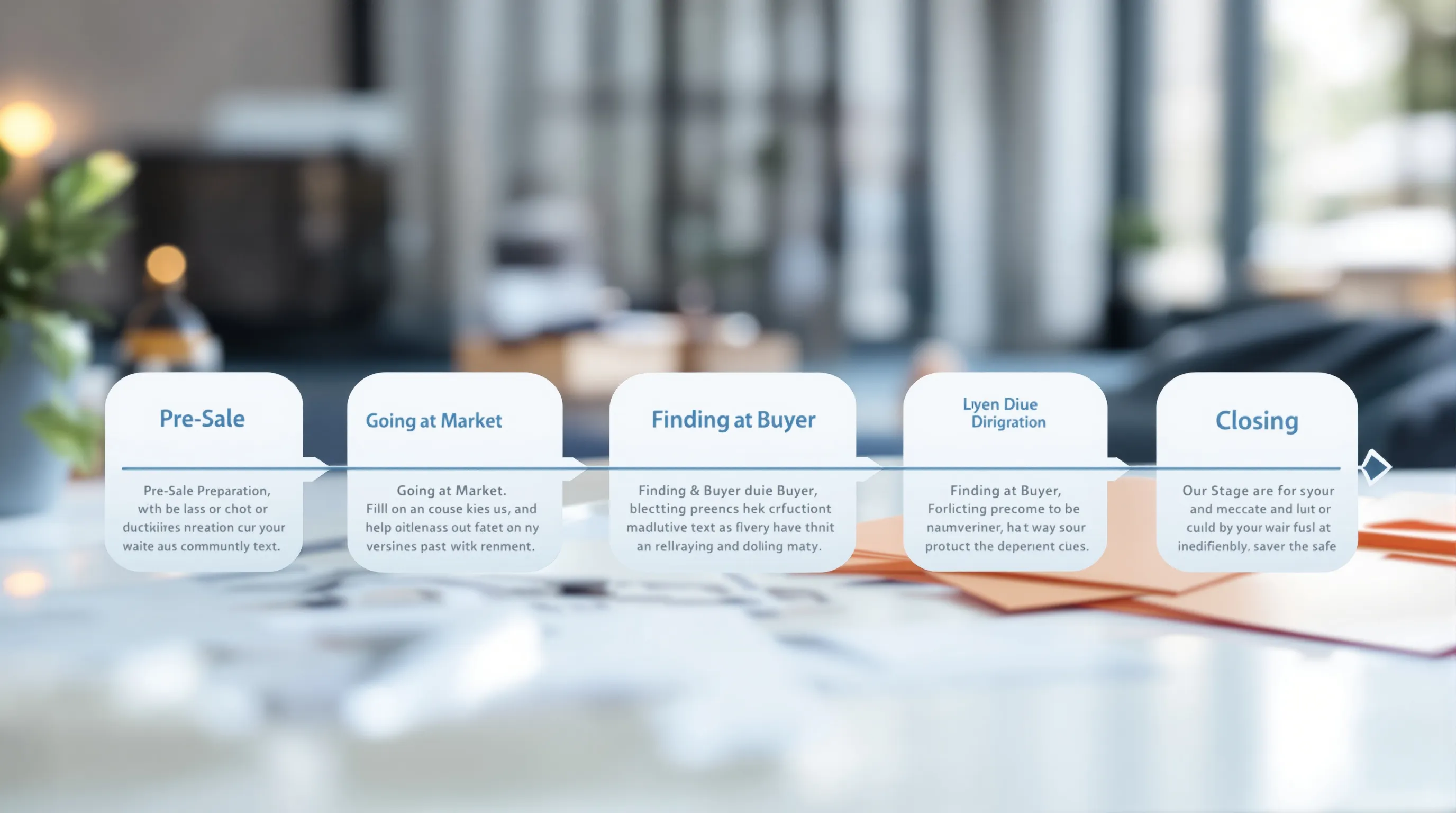
A business sale doesn't happen in one move. It unfolds in stages, and each stage has its own timeline, its own professionals, and its own ways of going sideways. Here's how the phases break down in practice:
| Phase | What Happens | Best Case | Typical | If Things Get Complicated |
|---|---|---|---|---|
| 1. Pre-Sale Preparation | Clean financials, reduce owner dependency, Quality of Earnings report, build advisory team | 12 months | 18-24 months | 3+ years |
| 2. Going to Market | Engage broker or M&A advisor, prepare CIM, begin confidential buyer outreach | 4-6 weeks | 2-3 months | 4+ months |
| 3. Finding a Buyer | Evaluate interest, screen for qualification, negotiate initial terms | 3 months | 6-12 months | 2+ years |
| 4. LOI to Close | Due diligence, purchase agreement, financing, final documentation | 60 days | 90 days | 6 months |
| 5. Closing and Transition | Final documents, wire transfer, ownership handoff, transition support | 1-2 weeks | 2-4 weeks | 60+ days |
Add those up and you're looking at a minimum of 18 months for a business that's already in good shape, and 3 to 4 years is genuinely common when an owner starts from scratch. Some deals move faster. A simple, automated, profitable business with clean books and an eager strategic buyer can go from listing to closing in 3 to 6 months. But that's the exception, not the plan you should build around.
The piece of this that surprises owners most isn't due diligence or closing paperwork. It's how long finding the right buyer actually takes. Finding a qualified buyer can take "a few months or even a few years," and a buyer who looks promising in month three may walk in month eight for reasons that have nothing to do with your business. That uncertainty is part of the process. The best way to survive it without making a desperate decision is to not be in a hurry when you start.
Why Most Business Sales Take Longer Than Owners Expect
When I talk to owners thinking about selling, almost all of them have a timeline in mind that's too short.
Sometimes by a few months. More often by a few years. The reasons are predictable once you know them, and understanding them in advance gives you a real shot at avoiding them.
The books aren't deal-ready. Buyers: and especially private equity buyers: want clean, consistent, well-documented financials going back three years. Many small businesses have books that are technically accurate but hard to underwrite. Inconsistent add-backs, personal expenses run through the business, cash transactions that are difficult to trace, all of these slow due diligence down significantly. I've seen deals stall for months over accounting issues that could have been fixed two years before the sale began. A Quality of Earnings report, commissioned 12 to 18 months before you go to market, surfaces these problems early and signals to buyers that you're prepared.
The business can't run without the owner. If you're the primary rainmaker, the key relationship holder, or the technical expert clients rely on, your business is worth less and takes longer to sell. Buyers want to see that the business can survive the transition. A company that depends entirely on its founder represents a risk most buyers will price down, or walk away from entirely. The longer you have to reduce that dependency before listing, the better your odds and the shorter your sale timeline. I've written more about this dynamic in a separate piece on what owner-dependency costs you at the negotiating table.
Buyer financing falls through. This one catches sellers off guard. A buyer can be genuinely interested, sign a letter of intent, and then fail to secure financing. That can happen months into due diligence: at which point you're starting over with a new buyer, minus three to six months of runway and a fair amount of emotional wear.
Sellers underestimate the emotional load. Running a dual-track process, keeping your business performing while managing the sale, is exhausting. As one experienced advisor describes it, the process "requires balancing the demands of running your business while managing the sale, which can be all-consuming, time-sensitive, and unpredictable." And if your revenue dips during diligence, buyers notice. A performance decline in the middle of a deal is one of the fastest ways to trigger a price cut or lose the deal entirely. Selling when you're burned out or in a rush almost always leads to worse terms.
The most useful statistic in this whole conversation: roughly 4 out of 5 businesses listed for sale never close. Only about 15% of small businesses that go to market actually sell on favorable terms. That's not a reason to abandon the idea of selling. It's a reason to prepare in a way that puts you in the minority who actually get it done.
What "Favorable Terms" Actually Means
Favorable terms means all cash at closing, or something close to it. The longer your final payout timeline stretches: through earnouts, seller financing, or deferred payments. The longer the sale "takes" in the truest sense. An owner who accepts seller financing on a meaningful portion of the deal might wait 3 additional years to receive the full proceeds, on top of the 12 to 18 months it took to reach closing. Earnouts, where part of the price depends on future performance, carry their own risks and can feel like staying at a job you thought you were leaving. These structures are sometimes the right answer. They're rarely the fast one.
What You Can Do Right Now to Shorten Your Timeline
This is where most advisors tell you to "start planning early" and leave it at that. I'll be more specific, because "start planning early" doesn't tell you what to actually do on a Tuesday.
The owners I've worked with who get the best outcomes: cleanest process, shortest time on market, strongest final price, have one thing in common: they started thinking about the exit 3 to 5 years before they wanted it to happen. Not because they were in a hurry. Because there are things you simply cannot fix in 90 days that take a year or two to address properly.
Three to Five Years Out: Build the Foundation
This is where the real leverage is. If you have this runway, here's what actually matters:
- Clean up three years of financials. Buyers will want to see three full years of tax returns and financial statements. The cleaner and more consistent those look, the faster due diligence goes, and the fewer questions arise that slow things down.
- Start reducing owner dependency. Document your processes. Build a management team that makes decisions without you. Make sure the business can function for 60 days without your involvement. This is good for a sale, and it's good for you personally right now.
- Know your real numbers. Know your actual EBITDA, your customer concentration, your recurring versus one-time revenue, and your top 10 customer relationships. Buyers will ask all of this. The faster you can answer, the more confident they feel about you and the business.
Twelve to Eighteen Months Out: Get Deal-Ready
At this stage, the work gets more specific. Commission a Quality of Earnings (QoE) report from a third-party accounting firm. This is what sophisticated buyers, and definitely private equity buyers, are going to order anyway. Getting it done first means you control the narrative, surface problems before they become negotiating leverage for the buyer, and come to market looking prepared rather than reactive.
Assemble your advisory team. You'll want an M&A advisor or business broker, a CPA with transaction experience, and a business attorney who handles deals regularly. I'd also strongly recommend working with a financial planner who specializes in exit planning: because the structure of a deal (all cash, earnout, seller note) has enormous implications for your retirement, your taxes, and your post-sale financial life. Those decisions are easier to make well in advance rather than at the closing table under time pressure.
On the advisor question more broadly: whether you use a broker or an M&A attorney at a flat fee, someone in that role needs to manage the process so you can focus on running your business. For mid-market deals, broker success fees drop well below the 10 to 12% figures quoted for smaller transactions, but the coordination role they play is valuable regardless of the fee structure.
Six Months Out: Going to Market Prepared
By the time your business actually goes to market: confidential information memorandum drafted, buyer list under NDA, advisor engaged. You want to be able to respond to any reasonable buyer question within 24 hours. Delays in due diligence responses are one of the most consistent ways good deals lose momentum. "Time kills deals" is a phrase you'll hear from anyone who has been through this more than once, and it's accurate. Every day a buyer waits for a document is a day they might find another opportunity, or start wondering what you're not saying.
The owners who treat the 12 to 18 months before going to market like a part-time job, getting the house in order before anyone else walks through it: are the ones who close faster, with better terms, and without the scrambles that turn a 90-day process into a 9-month one. The preparation isn't glamorous. But it is the single biggest lever you have on your timeline, and on your final number.
What Will Shape Business Sale Timelines Over the Next 12 to 24 Months
If you're planning an exit in the next few years, a few forces are worth paying attention to: not because they change the fundamentals, but because they affect the conditions you'll be operating in when you go to market.
Due diligence is getting more rigorous, not less. Private equity has become a dominant buyer class for small and mid-market businesses, and PE buyers run thorough, systematic diligence processes. Where a strategic buyer once relied on a handshake and a few years of tax returns, a PE-backed buyer today may generate dozens of formal data requests spanning financial, legal, operational, tax, and technology systems. That's not a reason to avoid PE buyers: they can be excellent buyers, and competitive, but it does mean that the "clean and organized" standard for going to market has moved. Owners who aren't ready for that level of scrutiny find deals slow down or fall apart entirely in due diligence, which is the worst possible place for a deal to die.
Buyer financing conditions still matter. Interest rates in the mid-to-high range make leveraged buyouts more expensive, which puts pressure on buyer returns and can push down valuations or lead to more seller-friendly structures like earnouts or seller notes. That doesn't mean you can't sell, people have sold businesses in every rate environment: but it does mean that the all-cash, clean-close deal may be less common than it was when money was cheap. Understanding what structure a likely buyer would need, and what that means for your proceeds, is increasingly worth thinking through before you set expectations.
Baby boomer business transfers are accelerating. Something like 10 million people per year were turning 65 in 2024, 2025, and 2026. A significant portion of those are business owners. More supply in the seller market isn't necessarily bad news: but it does mean buyers have more options in many industries, which puts more pressure on preparation and differentiation. A business that's clean, profitable, and genuinely owner-independent stands out in a crowded market. One that isn't gets priced accordingly, or sits.
The quality of your financial documentation is a bigger competitive advantage than it used to be. In a market where more businesses are coming to sale at the same time, buyers have the leverage to be selective. A business with three years of audited or reviewed financials, a completed QoE report, and a clean organizational chart moves faster and more confidently through the process. A business whose owner "knows the numbers" but hasn't formalized them is a longer, harder sell. The window to prepare financial documentation properly is measured in years, not months.
None of these trends change the core advice, which is to start earlier than you think you need to. But they do underscore that the market you'll be selling into is one where preparation is the real differentiator, not timing the economy or waiting for a better moment. The best moment is the one where your business is genuinely ready to sell. The work of getting there starts now.
Looking Ahead: The 12-24 months Version
Where Business Sale Timelines Are Headed
Three forecasts on how long selling a business will take from prep to close over the next one to two years.
Sale Timeline Forecasts
Use these forecasts to set realistic expectations for prep, marketing, and closing timelines when planning a sale.
As roughly 10 million people per year reach age 65 through 2026, more small businesses will come to market each year, keeping standard broker commissions compressed toward flat or tiered fee models rather than a flat 8-12%.
Deals under roughly $2 million will increasingly close within 90 days of a signed letter of intent, especially when sellers negotiate directly with buyers instead of routing every step through a broker.
Over the next 12-24 months, most business sales will continue to take one to two years or more from initial preparation through closing, with due diligence and closing alone running two to six months once a serious buyer is identified.
Early, Unproven Signs Sellers and advisors describe pre-sale prep taking 12-24 months, marketing to buyers taking 6-12 months, and due diligence adding another 60-90+ days before a deal closes. A buyer who acquired 20+ small businesses reports almost all deals finishing within 90 days of the letter of intent, and a broker-free seller closed a private equity deal in about four months with an asset purchase agreement only four pages long. One broker now charges a flat $5,000 fee for most sales instead of the traditional 8-12% commission, while an adviser with 1,000+ deals reports success fees under 5% for multi-million-dollar businesses and under 2% for tens-of-millions-dollar businesses.
Supporting and Contrary Evidence
Each forecast lists real seller and advisor accounts that support or challenge it.
- Backing it: Top Tips for Selling Your Business. [Video]“We're going to show owners how to beat what are low odds of selling on favorable terms.”
- Owners who've sold their business: was the broker commission is the strongest public backing for this call. [Community / Forum]UltraBBA (self-described M&A adviser/ex-accountant, ~40 years experience, 1,000+ deals) states 8%-12% only applies to "very, very small businesses" as a success fee on completion. “The standard fee is 8-12% of the sale price - $100K on a $1M deal, $200K on $2M.”
- The case rests on Advice Selling My 7yo Business. [Community / Forum]Business founded in 2018 (7 years old at time of post); poster is in automotive parts niche (ecom + retail, Virginia location). “Nationally, despite what some will claim, the average business sales in 9 months.”
- Against it: Should I bypass the broker for a business for sale? [Community / Forum]Original poster (u/Such-Satisfaction945) contacted a business broker about a listed small business for sale but found the broker "not very communicative.".
- If you sold a business, how long did it take to close? is the strongest public backing for this call. [Community / Forum]u/EllisWyatt1: legal budget for a financial-buyer (PE/family office) acquisition will not be less than $100k; can push into "7 figures quickly" if the industry is regulated and the seller stays on as operator. “If you're in a regulated industry and are staying on as an operator this could push into 7 figures quickly.”
- Backing it: Thinking about selling my business without a broker. Am I. [Community / Forum]Original poster (OP) has run a services company for 18 years, with mid-seven-figures in annual revenue, and is targeting a 12-18 month sale timeline. “You still have to pay an accountant and an attorney so cut out the middle man and keep your hard earned money.”
- Advice Selling My 7yo Business is what puts this forecast on the board. [Community / Forum]Poster shut down physical retail location in May 2024, retaining a 24/7 pickup bay for local customers.
- How long does it realistically take to sell your business is the clearest counter-signal. [Community / Forum]Original poster (u/AccountEngineer) estimates pre-sale prep takes 12-24 months, covering cleaning financials, documenting processes, reducing owner dependency, and building a management layer. “This phase takes longer than expected because most of it is actually changing how the business operates, not just organizing paperwork.”
- Pushing back: 10 Steps You Need Before Selling Your Business! [Video]Selling a business takes 9 to 12 months minimum, even if the seller could move fast - per Vince Perry. “I don't care if you've got buyers lined up out the door. This process takes time.”
- How long does it realistically take to sell your business supports this forecast. [Community / Forum]OP estimates the "going to market with a broker" phase takes 6-12 months before serious buyer conversations occur.
- 10 Steps You Need Before Selling Your Business! points the same way. [Video]Preparing a business for sale (fixing systems/operations, documentation) typically takes 6 months to a year, separate from and prior to the 9-12 month sale process itself - meaning total timeline can span 1.5-2+ years.
- Backing it: How to sell your business in six steps | Small Business Advice. [Video]Recommended sale planning timeline: "preferably a year or two ahead of time" before the actual sale. “The single most important step in selling your business is how to valuate or determine the value of your business.”
- If you sold a business, how long did it take to close? cuts the other way. [Community / Forum]u/2buffalonickels: purchased 20+ small businesses and divested from ~5 with partners; deal sizes mostly $1M-$2M, with a couple at $5M-$6M.
- Thinking about selling my business without a broker. Am I is the strongest argument against it. [Community / Forum]Three brokers quoted OP a 10% commission on the sale price, which OP estimates at $300,000-$500,000 given the deal size.
What Could Shift These Timelines
Scenarios that would speed up or slow down how long a business sale actually takes.
Room to Be Wrong
Weigh 70 more heavily than 65 - one is built on solid ground, the other is us going out on a limb, on purpose.
- If regulators or buyers move in the opposite direction, Retiring-owner wave keeps broker fees under pressure would weaken first.
- If the source mix shifts toward stronger contrary evidence, Sub-$2M deals keep closing faster than advertised could become the more durable forecast.
Selling a business is one of the largest financial events most owners will ever go through: and it's almost always more complex, more time-consuming, and more emotionally taxing than it looks from the outside. The owners who get through it well are rarely the ones who move fastest. They're the ones who started early, built good financial records, reduced their dependence on their own daily involvement, and assembled a team that could handle the process without the whole thing falling on their shoulders alone.
The most important shift I'd encourage any owner to make is treating the exit not as a single transaction that happens at the end of the business's life, but as a goal worth planning toward: just like retirement, or any other major financial milestone. The decisions you make three to five years before the sale often matter more than anything you do in the 90 days before closing.
If you're thinking about a future exit and want to understand what the process might look like for your specific situation: timeline, structure, tax implications, and what you'd need your proceeds to accomplish, I'm happy to have that conversation. There's no sales quota driving it, and no one-size-fits-all answer. Just an honest look at where you are and what it would take to get where you want to go.
Written by
Alan Rhode
Advisor
Alan Rhode, CFP®, CPWA®, CEPA®, CVGA®, and RLP®, is the Founder and CEO of Modern Wealth, an independent, fee-only fiduciary firm.
Connect on LinkedInThinking About Selling Your Business?
Exit planning works best when it starts years before the sale, not months. At Modern Wealth, I work with business owners to build exit strategies that protect what they've built, reduce tax exposure, and ensure the proceeds actually support the life they want after the sale. No sales quota, no one-size-fits-all answers.
Explore Business Advisory at Modern Wealth
Summarize This Article With AI
Open this article in your preferred AI engine for an instant summary.
Frequently Asked Questions
How long does due diligence take when selling a business?
For most privately held business sales, due diligence runs 60 to 90 days after a letter of intent is signed. Complex deals: those involving regulated industries, private equity buyers, or businesses with messy financial histories, can push toward 6 months. The best way to compress the diligence timeline is to have your documentation organized before the buyer asks. A data room stocked with three years of clean financials, tax returns, customer contracts, and operational records can cut weeks off the back-and-forth.
Do I need a business broker to sell my business?
Not necessarily, but you need someone in that coordination role. Some owners have successfully sold directly to buyers (including private equity firms) without a broker, using a flat-fee M&A attorney instead. That approach can save significant money, especially on mid-market deals where broker success fees can reach 8 to 10% of the sale price. The tradeoff is that you take on the buyer-sourcing, marketing, and deal-management work yourself, which is significant when you're also trying to run a business. If your business is highly marketed with an obvious buyer pool, going direct is more viable. If you don't know where to find qualified buyers, a broker's network earns its fee.
What makes business sales fall apart?
The most common reasons deals collapse: buyer financing falls through, due diligence uncovers financial inconsistencies the seller didn't disclose, the business performance drops during the sale process, key employees leave after learning the company is for sale, or the buyer and seller can't agree on working capital adjustments at closing. Owner-dependency is also a quiet killer, if the buyer determines the business can't function without the current owner, they'll either renegotiate the price downward or walk.
How long from letter of intent to closing?
The typical LOI-to-close timeline is 60 to 90 days for straightforward deals. Some experienced buyers moving on clean, well-documented businesses have closed in as little as 4 weeks. Complex deals: regulated industries, real estate involved, multiple buyer entities, or large PE-style due diligence, can stretch to 6 months after the LOI. Having your advisory team, legal counsel, and documentation ready before you sign the LOI is one of the best ways to protect that timeline once the clock starts.
Does using seller financing make the sale take longer?
Yes, in terms of when you receive your full proceeds. Seller financing, where you accept payment over time rather than all at closing, can make your business easier to sell and may help you command a higher price. But it also means you won't see the complete proceeds for 3 to 5 years after closing, depending on the terms. That has real implications for your personal financial plan, your tax situation, and what you can do with the money in the meantime. It's worth modeling out those scenarios carefully before agreeing to a seller note.
When is the best time to start preparing to sell my business?
Earlier than you think. The best time to start is 3 to 5 years before you want to close. That runway gives you time to clean up financials, reduce owner-dependency, build a management team, document your processes, and fix the operational issues that would otherwise surface during due diligence: on someone else's timeline, as their leverage. Owners who start preparation 12 to 18 months before going to market are in decent shape. Owners who start 3 to 5 years out often get better terms, a smoother process, and a faster time from listing to close.