
Quick Answer
The Short Answer
Bundled wealth management platforms typically charge 1.5% to 2%+ of assets under management annually once you include the advisory layer, platform fees, and fund expense ratios. A standalone fee-only fiduciary usually charges 0.75% to 1.0% all-in. On a $2 million post-sale portfolio, the difference is $10,000 to $20,000 per year. Over ten years at a 6% annual return, that gap compounds to roughly $200,000 to $250,000 in retained wealth. The data you put into a bundled platform is also typically slow to move if you want to switch advisors later.
Most owners who sign up with a bundled wealth management platform do so within the first 60 to 90 days after a sale. The onboarding is smooth, the technology looks impressive, and the stated fee sounds reasonable. Nobody handed them a ten-year cost comparison. Nobody mentioned that the data they were about to deposit into the platform would take weeks to extract cleanly if they ever wanted to leave. And nobody put the total annual fee, advisory plus platform plus fund expenses, on a single line before they clicked agree.
This article does that. It breaks down what the all-in fee on a bundled wealth management platform actually looks like, runs the ten-year math on the cost difference between bundled and fee-only structures, and explains what data portability looks like in practice. If you have just closed a sale and are evaluating how to manage the proceeds, this is the comparison the sales deck left out.
Business owners who close a sale and move proceeds to a bundled wealth management platform typically pay 1.5% to 2.1% in all-in annual fees, once you account for the advisory layer, the platform or technology fee, and the fund expense ratios inside the recommended portfolio. A fee-only fiduciary engagement covering comparable planning and investment management typically runs 0.75% to 1.0%. On a $2 million portfolio, that gap is $10,000 to $22,000 per year. Over ten years at a 6% return, it accumulates to a six-figure difference in retained wealth.
The platform vendors are not hiding this. The information lives in the ADV Part 2, the fund prospectuses, and the fee schedule appendix you received at onboarding. It is just rarely presented on one screen, at one moment, in a way that makes the comparison obvious. What follows is an attempt to fix that.
Three Questions to Ask Before You Sign Anything
- What is the all-in annual fee, including the platform layer and fund expense ratios? Ask for this number in writing. The headline advisory rate is not the number you actually need.
- What does my data export look like if I decide to leave? Ask specifically about cost-basis records, performance history, and financial plan documents. Get this answer before onboarding, not after you have already deposited seven years of records.
- After the initial financial plan is complete, what does the ongoing engagement look like month to month? This question separates advisors who actively manage from those who build once and collect at the same rate indefinitely.
What Does 1.5% to 2% Actually Buy You?
When a wealth management platform quotes you an annual fee, the number on the screen is rarely the number leaving your account each year.
The fee structure on most bundled platforms runs in layers: an advisory fee (the number they show in the presentation), a platform or technology access fee (sometimes called a "wealth management access fee" and buried in the fine print), and the expense ratios inside every fund they place you in. Each layer is modest on its own. Together, they routinely push the all-in cost to 1.5% to 2.1% annually.
I have had clients arrive after three years with a major digital advisory platform who believed they were paying 0.89%. When we totaled the advisory layer, the platform layer, and the weighted average expense ratio of the fund lineup, the real number was 1.63%. That is not a rounding error. On a $2 million portfolio, that gap is roughly $14,800 per year between what they believed they were paying and what was actually being drawn down.
The platform fee is the piece that trips people up most often. Some firms call it a "wealth management platform access fee." Others fold it into the advisory percentage so quietly that you would need to read the ADV Part 2 carefully to find it. The software dashboard, the account aggregation tool, the mobile app, the "AI-powered insights"? You are paying for all of it through that all-in rate, whether or not you use any of those features in a given year.
What does the software layer actually buy? Aggregated account views, tax-loss harvesting automation, and rebalancing alerts are the standard selling points. These are real features. They are also available through standalone tools that charge a flat fee of a few hundred dollars per year, or that a fee-only advisor can include without embedding them in a percentage of your assets. The problem is not that the software is worthless. The problem is that you are paying for it as a percentage of wealth, which means a $4 million client pays four times as much for the same dashboard as a $1 million client, for identical functionality. That math does not track with the value delivered.
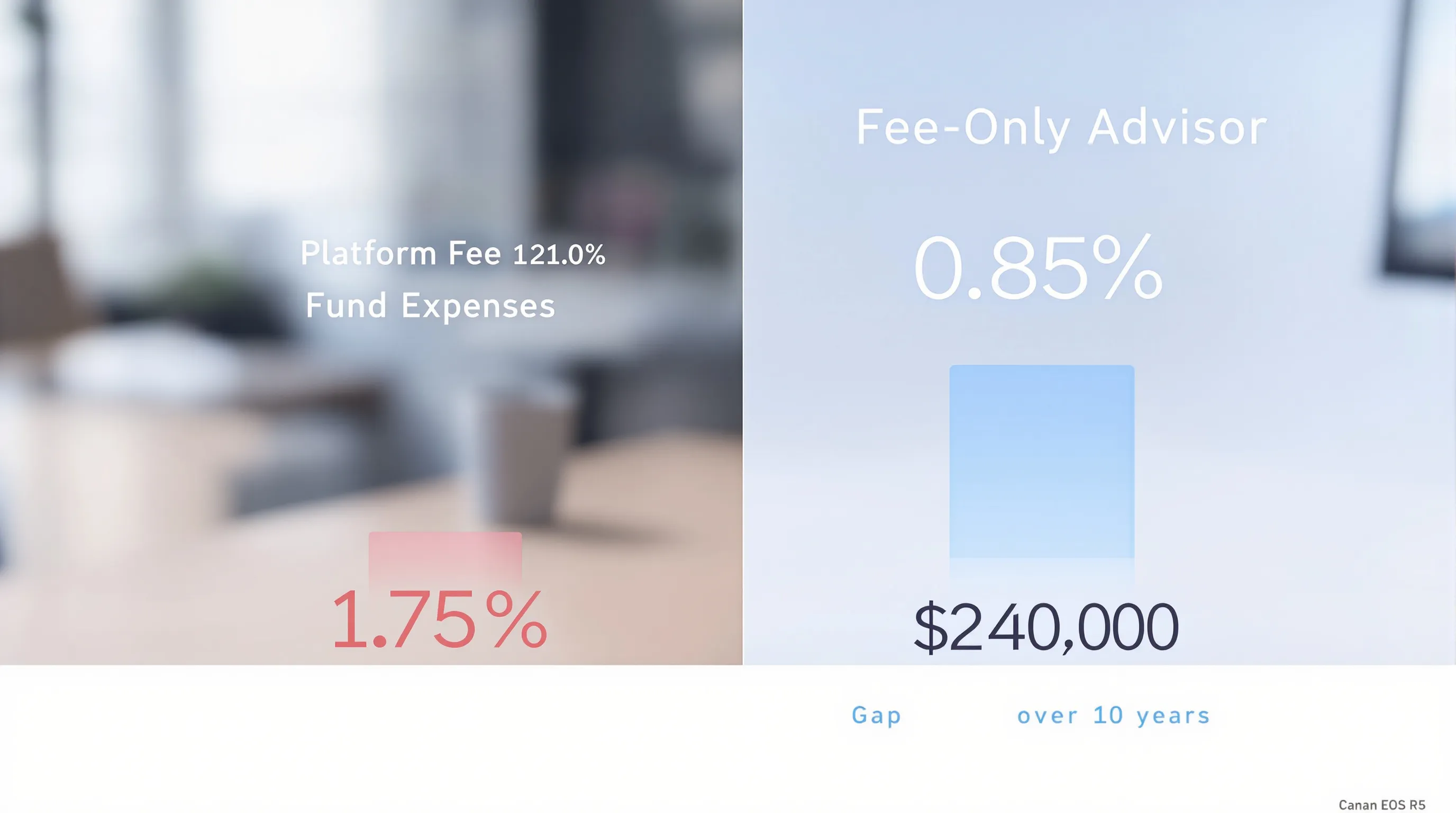
A reasonable all-in breakdown on a $2 million portfolio at 1.75%: roughly $17,500 in advisory, $7,000 in platform costs, and $10,500 in underlying fund expenses. That is $35,000 per year for an arrangement many owners assume costs closer to half that amount. The number never appears on a single line anywhere in the sales materials.
The Ten-Year Math Nobody Shows You at the Sales Presentation
Nobody at the sales presentation volunteers to run a ten-year cost comparison. I understand why: it is not a compelling visual for closing a new client.
But it is exactly the number you need before committing to a fee structure on proceeds you just spent years building.
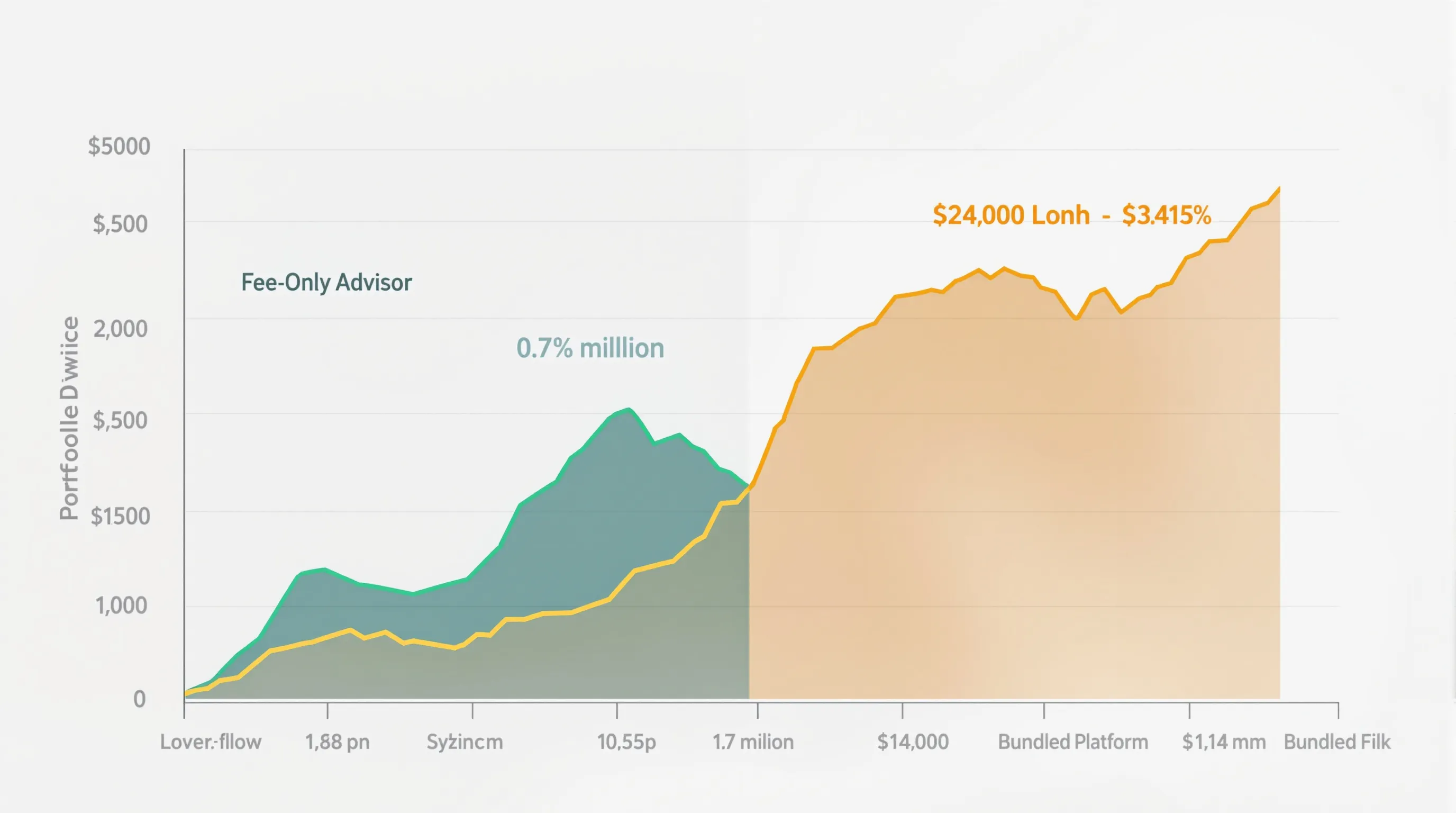
Here is the math, kept simple. Take $2 million in post-sale proceeds invested at a 6% annual return. Over ten years with no fees, you would have roughly $3.58 million. Apply a 1.75% all-in annual fee (a reasonable midpoint of the bundled platform range) and the ending balance drops to approximately $3.14 million. Apply a 0.85% all-in fee (a competitive fee-only engagement) and the ending balance is approximately $3.38 million. The difference between those two outcomes is roughly $240,000. That is not a hypothetical. That is the gap between two contractual choices you are making right now, during the weeks after a sale when everything feels urgent and the onboarding deck is polished to a high shine.
I show this math to clients not to alarm them, but because I think they deserve to see it before they decide. Choosing a fee structure without running this calculation is a little like choosing a mortgage by looking only at the monthly payment without checking the interest rate. The monthly number feels manageable. The thirty-year number tells a different story.
Compounding works in both directions. A dollar saved in fees today is a dollar that earns returns for the next ten years. Reducing your all-in fee by 0.9 percentage points on a $2 million portfolio is roughly equivalent to an extra $18,000 per year in gross returns, without requiring any change to your investment strategy or any tolerance for additional market risk. You would not walk away from a guaranteed 0.9% return enhancement. This is that same outcome, delivered as a fee reduction, and it does not require investment skill or market timing.
The bundled platforms will tell you the premium is justified by comprehensive planning, tax optimization, and proactive advice. Sometimes that is true. More often, the intensive planning work happens in the first eighteen months and then the account is managed on something close to autopilot at the same 1.75% rate. Ask any prospective advisor: after the initial plan is built, what does the ongoing engagement look like in a typical month? Ask for specifics, not a service description. The answer will tell you more than the fee disclosure ever will.
Data Lock-In Is the Part Nobody Mentions During Onboarding
The fee is the visible cost. The data situation is the one that catches owners off guard, usually at the moment they have already decided they want to make a change.
Most bundled wealth platforms store your transaction history, cost-basis records, performance attribution, and account aggregation data in their own proprietary system. When you ask to export, they will generally produce a CSV file. What they will not produce is a clean handoff. Cost-basis data may require reconstruction if the original lots were transferred in from multiple custodians. Performance history is often formatted to the platform's internal reporting standards, which do not map cleanly to another advisor's system. Financial plan documents may live inside a proprietary planning tool you can no longer access after the account is closed.
In my experience working with clients who have moved from bundled platforms to fee-only arrangements, the practical data migration takes four to six weeks at minimum, and sometimes stretches to three months when tax-lot records require manual reconstruction. That timeline is long enough that most clients end up paying two sets of fees during the transition period: the outgoing platform through the notice period, and the incoming advisor who is organizing everything in the background. It is not fraud. It is an inconvenient structural feature of how these systems are designed, and it is worth understanding before you commit to a platform rather than after.
Notice periods compound the problem. Many platform agreements include a 30-day termination notice clause, and some run to 60 days. You sign those terms during onboarding when you are focused on the investment policy statement and the initial plan, not the exit provisions. By the time you want to leave, the clock has already started and it runs against you.
I have watched clients delay changing advisors for six months, not because they were satisfied with the current arrangement, but because the migration felt overwhelming and the timing never seemed right. That delay is not free. At 1.75% on $2 million, a six-month delay costs roughly $17,500 in additional fees paid to a firm you are already trying to leave. Data lock-in is not accidental. It is a retention mechanism built into the platform architecture, and knowing that before you sign changes the questions you should be asking at the onboarding meeting.
Before and After: The Cost of Not Asking
Before: Signing Without the Full Number
A business owner closes a $4 million sale and, within 60 days, signs with a well-marketed digital advisory platform. The onboarding is smooth, the technology is modern, and the stated advisory fee is 0.95%. The owner assumes this is the all-in cost. Three years later, when calculating actual returns, the full picture surfaces: the platform layer and fund expenses push the real all-in figure to 1.68%. On $4 million, that is $67,200 per year. Over five years, the fee gap versus a 0.85% fee-only engagement totals roughly $330,000.
After: Requesting Total Cost First
The same owner, before signing, asks the advisor to provide total cost of ownership in writing, including fund expense ratios and any platform fees. She reviews the ADV Part 2, compares three options including a fee-only fiduciary firm, and selects the arrangement with the clearest all-in pricing at 0.85%. She confirms data portability terms before onboarding so she knows exactly what switching looks like if she ever needs to. Over five years, the $330,000 that would have funded the platform's overhead stays in her portfolio instead.
What Will Change in the Next 12 to 24 Months
The bundled platform model is under regulatory pressure it has not faced before. The SEC's focus on total cost transparency in advisory relationships is moving from guidance toward enforcement, and several large platforms have already updated their fee disclosure documents in response. Whether that results in genuinely clearer pricing or just more detailed footnotes remains to be seen, but the direction is toward more disclosure, not less. Owners evaluating platforms in 2026 and 2027 should expect to see revised fee schedule formats that attempt to surface the all-in cost more explicitly.
At the same time, the flat-fee financial planning model is growing meaningfully among independent advisors. A number of fee-only practitioners have moved away from AUM-based pricing entirely, charging a flat annual retainer for planning and keeping investment management costs separate and low. For owners managing $2 million or more in post-sale proceeds, a flat retainer plus a low-cost portfolio structure may undercut the bundled model substantially, and the math on that comparison is simple to run before you commit to anything.
The AI framing that dominates current platform marketing will face a more useful test over the next two years. "AI-powered insights" and "intelligent portfolio management" are easy to put in a slide deck. Demonstrating that these features produce better after-cost outcomes than a simpler fee-only arrangement is a different question, and owners are starting to ask it. The feature comparison is shifting toward a cost-adjusted performance comparison, which is the more honest question for anyone choosing how to manage post-sale proceeds.
Data portability regulation is early-stage but moving in a useful direction. Regulatory interest in financial data portability standards, paralleling what has already happened in banking through open finance frameworks, may reduce switching friction over the next three to four years. That would change the retention economics for bundled platforms meaningfully. For now, the friction is real. The platform you enter easily is not necessarily the platform you exit easily, and the cost of that asymmetry belongs in your evaluation before you sign.
What Might Happen Over the 12-24 months
Where advisory and platform fees head next
Three scored forecasts on what a newly liquid owner will actually pay to manage proceeds over the next one to two years.
Fee forecasts for large liquidity events
Use each forecast to pressure-test a bundled quote before you commit assets to any one platform.
Even as advertised advisory percentages compress, the total cost of a platform-plus-advisory bundle is likely to rise over the next 12-24 months. Average annual retainers already surged 52% since 2023, managed-account sleeves add up to 0.35%-0.40% above the advisory fee, and exchange, dealer, and third-party pass-through charges sit outside the quoted range. Rising software costs reported by 41% of business owners and a wealth-software market growing at a 14.7% CAGR toward $18.77B by 2033 keep upward pressure on the layers buyers never see.
Over the next 12-24 months, large and pooled clients will win better terms as group negotiation and disclosure norms spread. A Chicago firm recently signed roughly 100 SpaceX employees representing $1B-$5B while negotiating lower advisory fees, AI-enabled platforms are being embedded into large-firm operations, and federal fee-disclosure rules already compel providers to itemize what they charge on retirement assets.
Over the next 12-24 months, owners placing eight-figure proceeds will increasingly be quoted flat annual or steeply tiered fees rather than a single AUM percentage. High-net-worth AUM fees already fall from 0.79% in the $2M-$10M band to 0.58% above $25M, two-thirds of advised households pay under 1%, and 21% have already switched to a flat annual fee.
Signals Worth a Raised Eyebrow One in five advised high-net-worth households have already replaced AUM billing with a flat annual fee, and the most common single bracket has settled at 1.00%-1.24%. Providers now stack a flat retainer, a separately billed manager sleeve, and undisclosed pass-through charges on top of the advisory percentage, so two quotes with the same headline rate can carry very different true costs. Pooled and employer-affiliated groups are already using collective scale to negotiate advisory fees down, a pattern individual liquid owners can borrow by demanding line-item disclosure.
Sources behind these fee forecasts
Both supporting benchmarks and contrary data points are listed so you can weigh each forecast yourself.
- Pros and cons of different advisory fee models - Envestnet supports this forecast. [Industry Publication]Source data throughout is a Datos Insights survey of 491 financial advisors, conducted Q1 2026 for Envestnet | MoneyGuide. “A survey of 491 advisors by Datos Insights for Envestnet | MoneyGuide reveals that only 9% of advisors are using this model in 2026, compared to 18% in 2023.”
- Fidelity Wealth Management Review 2026 - unbiased.com is the strongest public backing for this call. [Industry Publication]Fidelity Wealth Management charges an annual asset-based advisory fee of 0.20%-1.50% (review body also cites a 0.5%-1.5% range), with the percentage declining as account size increases. “Optional SMAs can add up to 0.4% in additional fees, resulting in a higher total cost.”
- The case rests on 41% Of Small Business Owners Report Rising Software Costs. [Industry Publication]Sample size: n = 781 (margin question n≈749). Survey year context: 2026. “New data from the Small Business Expo Research Desk (n=781) shows that 41% of small business owners report that software costs have increased over the past 12…”
- Wealth Weekly News Roundup | 6.12.26 - AGM Alts is the strongest public backing for this call. [Substack / Newsletter]Credit secondaries were a $20B+ market in 2025 per Carlyle. Dynasty platform serves RIAs at $125B; Gen II administers more than $1.5T of fund assets. “there's going to be a price to pay as far as what that means for private equity performance for [those vintages].”
- Backing it: Fee Disclosure Failure Notice | U.S. Department of Labor. [Government]The notice mechanism exists to report a service provider's failure to disclose fee information required by the Department's 408(b)(2) regulation. “On prohibition: *"the contract or arrangement between the plan and the service provider is prohibited by ERISA, and the responsible plan fiduciary will have…”
- Wealth Management Fees for High-Net-Worth Individuals | Long Angle is the strongest public backing for this call. [Industry Publication]Long Angle's 2026 High-Net-Worth Asset Allocation Report benchmarked 233 HNW investors with an average net worth of $17M; among advised respondents the average AUM-based fee is 0.70%. “The question most investors at this stage are actually asking is not what wealth management costs in the abstract, but whether the standard 1% AUM model still…”
- The case rests on Wealth Management Fees for High-Net-Worth Individuals | Long Angle. [Industry Publication]AUM fees compress with wealth: 0.79% in the $2M-$10M bracket, 0.67% in the $10M-$25M bracket, and 0.58% above $25M.
- Pros and cons of different advisory fee models - Envestnet is what puts this forecast on the board. [Industry Publication]90% of financial advisors charge a fee for financial planning, driven by a shift toward comprehensive, planning-led services.
- How 1% fees cost you a third of your nest egg supports this forecast. [Community / Forum]A 1% assets-based fee is charged on total assets invested, not on profit - the central mechanic of the whole argument. “Or rather, you can trust them - to manipulate and take advantage of you.”
What could move these fee predictions
These scenarios describe the market shifts that would push total cost the opposite direction from the forecast.
Room to Be Wrong
95 is where the evidence is strongest; 95 is where we're leaning against the crowd, so treat it accordingly.
- If a worsening advisor shortage would reverse the buyer-friendly trajectory: McKinsey projects advisor demand rising 28%-34% by 2034 with 42% of advisors retiring and a shortfall of 90,000-110,000.
- If that scarcity arrives faster than expected, providers regain pricing power and both headline and all-in fees firm up instead of compressing.
$240,000
Estimated ten-year difference in retained wealth between a 1.75% all-in bundled platform and a 0.85% fee-only engagement on a $2 million portfolio at a 6% annual return. This number accumulates quietly, inside every quarterly statement, until someone runs the math.
What the Pricing Page Shows and What Your Statement Reflects
Wealth management platforms are not trying to mislead you. But they are trying to close you, and the number they lead with is never the all-in number.
That gap receives less scrutiny than it deserves during onboarding, when everything is moving fast and the advisor is helpful and the paperwork is thick.
The headline fee on most platforms refers to the advisory or investment management layer only. What the pricing page does not show: the underlying fund expense ratios (typically 0.05% to 0.40% depending on whether the portfolio uses index funds or actively managed products), any platform access or technology fees, financial planning fees that may be billed separately, and, in some arrangements, insurance product commissions if the firm offers those services. None of these appear in the headline rate. All of them appear somewhere in your quarterly statement.
The ADV Part 2 is the document where advisors are required to disclose all compensation. It is a public filing, available through the SEC's Investment Adviser Public Disclosure database. I encourage any owner receiving post-sale proceeds to read the ADV Part 2 of any firm they are evaluating before signing. Look specifically at the Fees and Compensation section and at Other Financial Industry Activities and Affiliations. The latter tells you whether the firm or affiliated entities receive compensation from products they recommend to clients. That is not automatically a disqualifier, but it is information that should factor into how you weigh the advice you receive.
The other number to request in writing: total cost of ownership on your specific asset level, including fund expense ratios, platform fees, and the advisory fee, expressed as a single annualized percentage. If the advisor cannot give you that number, ask why. A fee-only fiduciary should answer this question immediately, because there is nothing to obscure. Any hesitation or redirection toward value instead of numbers is a signal worth noticing, not a reason to feel reassured.
At Modern Wealth, I charge a straightforward percentage of AUM with no product commissions and no platform surcharges layered on top. The number I quote is the number that leaves your account. I say this not to advertise, but because watching clients discover the gap between what they believed they were paying and what they were actually paying has made me value plainness in a way I did not when I started this work.
How Modern Wealth Approaches This for Post-Sale Owners
After a business sale, the decisions arrive fast and they carry real weight. Tax structuring on the proceeds, liquidity deployment, estate coordination, retirement income planning: it is a lot, and it tends to land simultaneously, during a period when you are also processing the emotional reality of having sold something you spent years building. The last thing you need is a fee structure quietly extracting 1.75% per year while you are still figuring out what comes next.
At Modern Wealth, I operate as a fee-only fiduciary. No product commissions, no platform surcharges folded into the advisory rate, no financial benefit from recommending one investment structure over another. The fee reflects the planning work, the investment management, and the ongoing advice. It is not padded with a software license you did not choose and may not use.
For post-sale owners, the first twelve months of engagement tend to be the most intensive: building the tax plan around the transaction structure, establishing the investment policy, coordinating with your attorney and CPA on estate and trust matters, stress-testing the retirement income projection against different spending scenarios and market conditions. That first-year work is where genuine planning value is created. The ongoing engagement after that should reflect a steady-state advisory relationship at a fee that acknowledges the different nature of the work, not the same intensive onboarding rate applied indefinitely. That distinction matters when you are pricing the multi-year total cost.
The records and data you bring to Modern Wealth stay yours. Account statements, performance history, planning documents, tax projections: I work in formats that transfer cleanly. If you decide at some point that a different advisor is a better fit for where you are, you take your records with you. I prefer clients who continue because the work is genuinely useful, not because leaving involves a three-month reconstruction project.
If you are evaluating advisors after a liquidity event, I am glad to have that conversation. You can visit the post-sale wealth management page to see how that engagement is structured, or you can read Fee-Only or Roll-Up: What Modern Wealth Management Means for more on how the fee-only model differs from the bundled approach. The initial conversation is free. The fee structure will be clear before you commit to anything.
Key Takeaways
Key Takeaways
- All-in fees on bundled wealth platforms typically run 1.5% to 2.1% annually once you account for the advisory layer, the platform or technology fee, and the underlying fund expense ratios. These are rarely presented together on a single line.
- A fee-only fiduciary typically charges 0.75% to 1.0% all-in with no platform surcharge or product commissions. On $2 million, the annual difference is $10,000 to $22,000.
- Over ten years at a 6% return, the fee gap on $2 million is roughly $200,000 to $250,000 in retained wealth, compounding quietly in every quarterly statement.
- Data lock-in is a structural feature, not an oversight. Platform exports in proprietary formats require four to twelve weeks to migrate fully, often with overlap fees during the transition.
- The ADV Part 2 is the document that tells the real story about fees and conflicts of interest. Read the Fees and Compensation section before signing any advisory agreement.
- Ask for total cost of ownership in writing before engaging any advisor: all-in annualized percentage including fund expense ratios and platform fees, not just the headline advisory rate.
The Decision You Are Actually Making
Choosing a wealth management arrangement after a business sale feels like a question about services and features. In practice, it is a decision about how much of your post-sale wealth you want to retain over the next decade. The platform features are real. The convenience is real. The fee drag is also real, and it compounds whether or not you are paying attention to it.
Running the ten-year math on whatever all-in fee you are being quoted takes about ten minutes and a spreadsheet. Requesting total cost of ownership in writing takes one email. Reading the ADV Part 2 takes one hour. None of this requires a financial credential. It requires about two hours of deliberate attention at a moment when most owners are moving quickly and trusting the firm with the cleanest onboarding process.
The decision is yours. I think it is better made with the full cost in front of you. If you want to compare what you have been quoted against what a fee-only engagement looks like, we are glad to have that conversation. You might also find it useful to read The Post-Sale Three: Decisions Software Can't Make, which covers what happens after the fee comparison is settled and the real planning work begins.
References
- U.S. Securities and Exchange Commission. Investment Adviser Public Disclosure (IAPD) database. advisers.sec.gov.
- Morningstar. (2024). U.S. Fund Fee Study. Morningstar Research Services.
- CFA Institute Research Foundation. (2023). Future of Finance: Total Cost of Ownership in Wealth Management.
- FINRA. BrokerCheck investor resource. brokercheck.finra.org.
- CFP Board. (2024). Standards of Professional Conduct for CFP Professionals. Certified Financial Planner Board of Standards.
- National Association of Personal Financial Advisors (NAPFA). (2024). The Case for Fee-Only Financial Planning.
- Kitces, M. (2024). Trends in Advisory Fees and Compensation Models. Kitces.com Financial Advisor Research.
- Investment Company Institute. (2024). 2024 Investment Company Fact Book.
- Journal of Financial Planning. (2023). AUM Fee Structures and Long-Term Wealth Outcomes. Vol. 36(8).
- U.S. Securities and Exchange Commission, Division of Investment Management. (2024). Form ADV Part 2 Requirements and Guidance.
Written by
Alan Rhode
Advisor
Alan Rhode, CFP®, CPWA®, CEPA®, CVGA®, and RLP®, is the Founder and CEO of Modern Wealth, an independent, fee-only fiduciary firm.
Connect on LinkedInThe verdict
A Framework for Evaluating Wealth Management Options After a Sale
When comparing advisors or platforms in the period after a liquidity event, four criteria tend to separate the genuinely useful from the expensively convenient:
Total cost, not headline rate. Ask every firm you are considering to quote the all-in annualized cost on your specific asset level, including fund expense ratios and any platform or technology fees. Request this number in writing. A fee-only fiduciary should provide it immediately, because there is nothing to obscure. Vagueness at this stage is information.
What ongoing advice looks like, specifically. After the initial financial plan is complete, what does a typical month of engagement include? How often do you meet or talk? Who initiates contact when market conditions change or your circumstances shift? The answer should reflect your actual situation and the advisor's real capacity, not a generic service tier description from the firm website.
Data portability terms, before onboarding. Ask how you export your complete financial record if you decide to leave. What formats does it come in? How long does a full migration typically take, including cost-basis records and performance history? Are there fees for data transfer or account closure? These questions feel premature during onboarding. That is exactly when you want the answers.
Conflict-of-interest structure. Does the firm or any affiliated entity receive compensation from products they recommend to you? This is disclosed in the ADV Part 2 under Other Financial Industry Activities and Affiliations. It is not automatically a disqualifier, but it changes how you should interpret the advice you receive and weigh the products you are offered.
These four questions fit inside a single conversation with any advisor you are evaluating. The answers cover most of what you need to decide whether the arrangement is right for you.
Frequently Asked Questions
What is the typical all-in fee for a bundled wealth management platform?
Most bundled platforms that combine software and advisory services charge between 1.5% and 2.1% of assets under management annually, once you account for the advisory layer, the platform or technology fee, and the fund expense ratios inside the recommended portfolio. The headline rate in marketing materials or the initial presentation is typically only the advisory portion of that total cost.
How does a fee-only advisor's cost compare to a bundled platform?
A standalone fee-only fiduciary typically charges between 0.75% and 1.0% of AUM annually, all-in, with no platform surcharge and no commissions from recommended products. On a $2 million portfolio, this difference is roughly $10,000 to $22,000 per year compared to a bundled arrangement at 1.5% to 2%. Over ten years at a 6% return, that gap compounds to approximately $200,000 to $250,000 in retained wealth.
What is data lock-in and why does it matter for wealth management clients?
Data lock-in refers to the friction involved in extracting your financial records, cost-basis history, and planning documents from a platform when you want to switch advisors. Most platforms store client data in proprietary formats that do not transfer cleanly to other systems. Reconstructing a complete record typically takes four to twelve weeks and may require paying overlapping fees during the transition. It is a structural feature of most bundled platforms, not an oversight or an unusual circumstance.
How do I find the real all-in cost of a wealth management platform?
Ask the firm to provide total cost of ownership in writing before signing: advisory fee, plus platform or technology fee, plus the weighted average expense ratio of the fund lineup they recommend. You can verify this against the firm's ADV Part 2, a public disclosure document available through the SEC's Investment Adviser Public Disclosure database at advisers.sec.gov. The Fees and Compensation section is the place to start, and you should read it before signing any agreement.
What does the ADV Part 2 tell me about an advisor's fee structure?
The ADV Part 2 is a regulatory filing that all registered investment advisers must maintain and provide to clients. The Fees and Compensation section details every fee charged and how it is calculated. The Other Financial Industry Activities and Affiliations section discloses whether the advisor or affiliated entities receive compensation from products they recommend, such as mutual funds, annuities, or insurance products. This is the most important section to read carefully before committing to any advisory relationship.
Is the software in bundled wealth management platforms worth the premium?
The features themselves, such as account aggregation, tax-loss harvesting automation, and rebalancing alerts, are genuinely useful. The question is whether paying for them as a percentage of your assets is the right structure for your situation. A $4 million client pays four times as much for the same dashboard features as a $1 million client, despite using identical functionality. Standalone portfolio management and financial planning software is available at flat annual fees that do not scale with your asset level.
What should I ask about data portability before signing with a wealth management firm?
Before onboarding, ask: In what format does my complete financial record export if I decide to leave? How long does a full migration typically take, including cost-basis records and performance history? Are there fees for data transfer or account closure? Is my financial plan stored in a proprietary tool I cannot access after leaving? These questions feel premature at onboarding. That is exactly when you want the answers, before you have deposited several years of financial records into a system whose exit terms you have not reviewed.
Summarize This Article With AI
Open this article in your preferred AI engine for an instant summary.