

Quick Answer
The short answer
The working-capital peg is a contractual adjustment mechanism in a business sale that compares your company's actual net working capital at closing to an agreed-upon target, usually the trailing 12-month average. If actual NWC falls short of the target, the difference comes directly out of your proceeds. On a $5 million deal, a $180,000 adjustment is not uncommon and typically does not appear anywhere on the term sheet you signed. The peg is fully negotiable, but your leverage to negotiate it disappears once you enter exclusivity with a buyer. The time to address it is before you sign the LOI, not after.
Working-capital adjustments reduce seller proceeds by 3 to 8 percent of headline purchase price in a typical middle-market deal, and most sellers first hear the term "working-capital peg" weeks after signing a letter of intent, which is approximately six weeks too late to negotiate it effectively. The mechanism is straightforward once you understand it: buyer and seller agree on a target level of net working capital at closing, then the seller reimburses the buyer for any shortfall when the actual figure falls short. On a $5 million deal, a $180,000 shortfall at closing is routine. On a $10 million deal, a $350,000 adjustment is not unusual. Neither number appears on the term sheet. This article explains what the working-capital peg is, why it consistently moves against sellers who are not prepared for it, and what to do about it before you are in the room.
Questions this article answers
- What is the working-capital peg and how does it reduce what I actually receive at closing?
- Why do sellers almost always end up on the short side of the working-capital adjustment?
- How do I negotiate a fair peg, and protect myself during the post-closing true-up?
Quick Answer
The number that gets announced in a business sale: the headline price, the one you tell your spouse over dinner while they say "really?", is almost never the number that arrives in your bank account. There are a lot of reasons for that gap: taxes, transaction fees, earnout structures, seller notes. But there is one mechanism that quietly reduces the check before anyone mentions taxes at all, and in my experience working with business owners through exits, it is the single most consistently misunderstood adjustment in a business sale. It is called the working-capital peg, and it operates almost entirely below the waterline of the deal.
Most sellers I work with have never heard of it until they are already deep into a purchase agreement. That is an expensive place to learn something for the first time. On a $5 million deal, a working-capital shortfall of $150,000 to $250,000 at closing is common. On a $10 million deal, the figure can be two or three times that. These are not edge cases caused by unusual situations. They are ordinary outcomes for sellers who did not know what the peg was, how it was calculated, or that they had any ability to negotiate it.
I am not trying to be dramatic about it. The working-capital peg is not a scam. It is a legitimate mechanism designed to make sure the buyer gets a business with enough fuel in the tank to operate from day one. But "legitimate" does not mean "fair to sellers who walk in unprepared," and walking in unprepared is exactly what most sellers do. What follows is what you need to know, and what to do about it before you are sitting across from a buyer.
What exactly is the working-capital peg, and how does it reduce what you actually receive?
Working capital is the operational cash cushion your business needs to run: current assets minus current liabilities. Accounts receivable, inventory, and prepaid expenses go in the asset column.
Accounts payable, accrued wages, and short-term obligations land on the liability side. The difference is the money the business needs on hand to cover today's bills while waiting for tomorrow's revenue to show up. As accounting practitioners note, net working capital is almost always analyzed excluding cash, short-term debt, interest payable, and tax balances: those are handled separately in the "cash-free, debt-free" structure that governs most private company acquisitions, as of .
The working-capital peg is a negotiated target, a specific dollar amount of net working capital the seller is contractually required to deliver at closing. Think of it as the amount of "fuel in the tank" the buyer expects to inherit with the business. The analogy shows up consistently in deal discussions: if you buy a car, it better have gas in it. If you buy a business, it better have enough working capital to keep running on day one without the buyer needing to immediately inject cash.
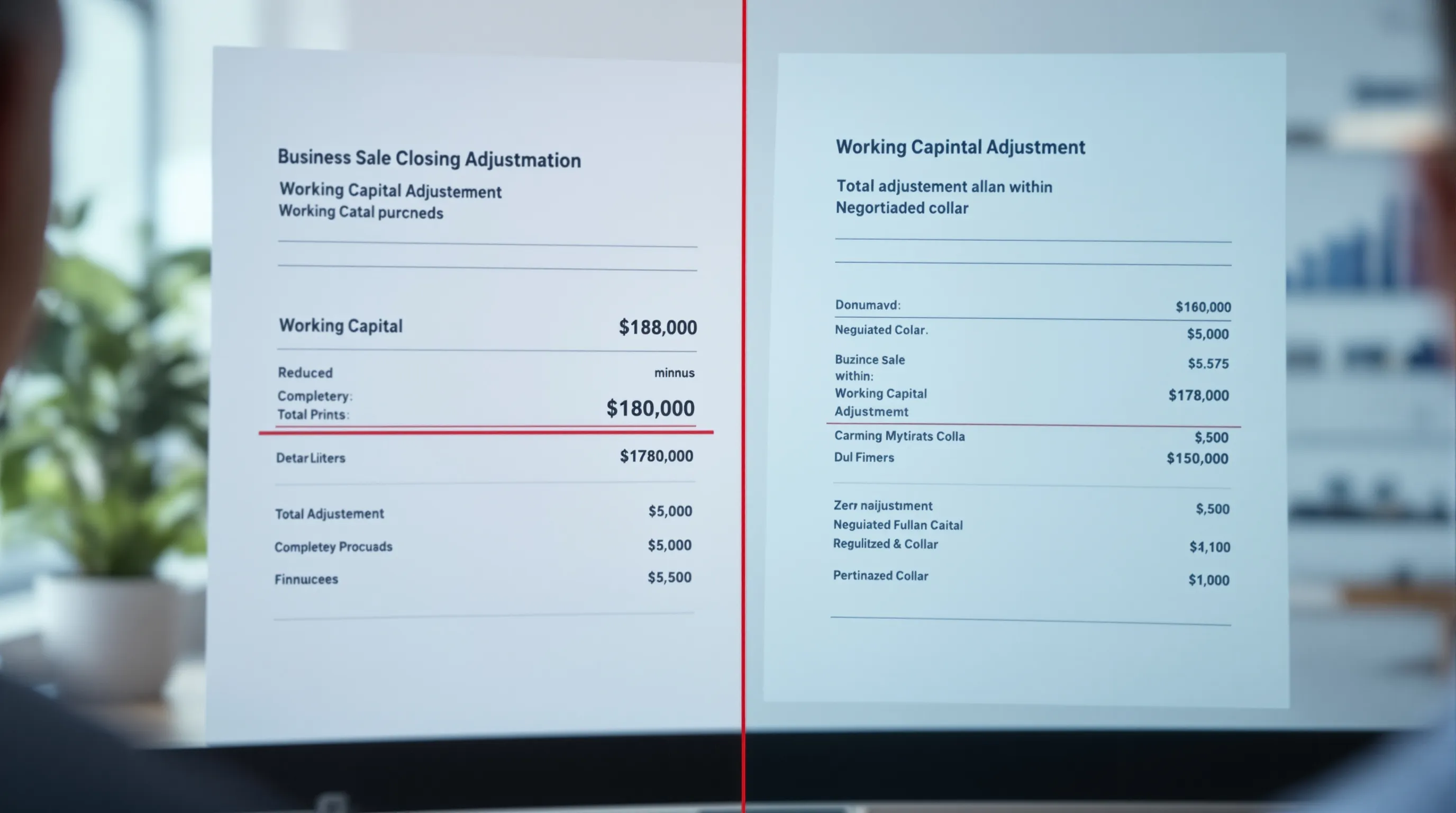
Here is how the math works in a real deal. Your business prices at $5 million. During negotiations, your trailing 12-month average net working capital is calculated at $450,000. That number becomes the peg. Closing day arrives. The closing balance sheet shows actual NWC of $270,000. Maybe receivables slowed. Maybe payables were paid down to clean up the books. The adjustment: $450,000 minus $270,000, or $180,000, comes directly out of your sale proceeds. Your $5 million check became $4,820,000, and no one wrote that reduction on the term sheet when everyone was celebrating the deal six months earlier.
The adjustment can work in your favor: if actual NWC at closing exceeds the peg, the buyer owes you additional consideration. In practice, that upside happens less often than sellers expect. A buyer offering a lower headline multiple with cleaner working-capital terms can produce a better outcome for both parties than a buyer offering a flashy number with an aggressive peg, but sellers rarely understand this until it is too late to matter.
| Working Capital Component | Typically Included in NWC | Common Dispute Point |
|---|---|---|
| Accounts Receivable (current) | Yes | Buyer may discount or exclude receivables over 60 to 90 days old |
| Inventory | Yes | Valuation method and treatment of slow-moving or obsolete items |
| Prepaid Expenses | Often yes | Whether the prepaid item has economic value to the buyer post-closing |
| Cash and Equivalents | Usually no | Most deals are structured cash-free, debt-free; cash stays with the seller |
| Accounts Payable | Yes, as a liability | Timing of payable recognition in the days surrounding closing |
| Deferred Revenue | Often yes, as a liability | The most-contested item: buyers argue sellers already collected this cash |
| Accrued Expenses | Yes, as a liability | Completeness, are all accruals properly recorded at closing? |
| Current Portion of Long-Term Debt | Usually excluded | Typically treated as "debt" in the price, not working capital |
The peg is almost always set as the trailing 12-month average of your net working capital, averaged monthly to smooth out seasonal swings. That average becomes the contractual obligation you must meet at closing. For seasonal businesses, this creates a specific trap: a YouTube tutorial on working-capital pegs for seasonal businesses illustrates how a company's 12-month average NWC can be $4.4 million while its peak-month figure runs $21.5 million, and a peg built on the annual average is completely inadequate to fund actual operations. If you close in a low-working-capital month, the math punishes you even if your annual average looks reasonable, and "the timing just wasn't great" is not a defense that reduces the adjustment.
Why do sellers end up on the wrong side of the working-capital adjustment so often?
The fundamental problem is timing. The peg gets set months before you close, and a lot can change between the letter of intent and closing day.
By the time you reach the finish line, your business has continued operating: collecting receivables at whatever pace your customers feel like, drawing down inventory, cycling through payables. The snapshot the buyer takes at closing rarely matches the historical average used to set the peg, and the math tends to cut in one direction.
There is also an information asymmetry that sellers rarely appreciate. The buyer's advisors, typically an accounting firm hired to run a Quality of Earnings analysis, have spent 60 to 90 days studying your financials in more detail than most owners ever do. As one M&A advisory piece puts it bluntly: "If you let the working capital language stay vague, you may watch purchase price bleed away after the deal is done." Walking into a peg negotiation without your own analysis is the deal equivalent of negotiating salary while the other side has everyone else's offer letters.
The deferred revenue trap that catches service businesses
If your business collects annual subscription fees, retainers, or advance payments, you carry deferred revenue as a liability on your balance sheet, money received but not yet "earned." Buyers sometimes argue this liability should be excluded from the working-capital calculation because the seller already collected the cash. Practitioners who work on small business acquisitions regularly flag deferred revenue as a significant dispute point, noting that two companies can show identical net working capital figures while being in fundamentally different financial positions depending on whether that balance is deferred revenue versus accounts payable. The treatment often costs sellers far more than they anticipated when they signed the purchase agreement.
The accounts receivable aging problem
Buyers routinely discount or exclude receivables older than 60 to 90 days. If your normal collection cycle runs 75 days, perfectly acceptable in your industry, a buyer may classify a meaningful slice of your current receivables as ineligible. The peg was calculated using your reported receivable balance. The closing statement will reflect the buyer's adjusted, aged view. The gap between those two figures comes directly out of your proceeds. Practitioners recommend tracking DIO (Days Inventory Outstanding), DSO (Days Sales Outstanding), and DPO (Days Payable Outstanding) to identify receivable patterns that buyers will scrutinize, and to detect "one-time events stretching AR or AP beyond typical ranges" before a buyer does.
Pre-closing manipulation that backfires
Some sellers, knowing the peg exists, try to inflate NWC in the weeks before closing by aggressively collecting receivables or delaying payables. Sophisticated buyers anticipate exactly this. The peg calculation methodology is built around trailing averages specifically because "right before a deal closes, a seller could just forget to pay its bills or delay them. That will increase accounts payable and reduce working capital. The buyer doesn't want that." Buyers apply normalization adjustments to strip out unusual working-capital surges near closing, leaving the seller with a higher effective peg and a lower check than they planned for. The manipulation strategy almost always costs more than it saves.
The post-closing true-up: the adjustment you thought was finished
Most purchase agreements use an estimated closing statement at closing, a good-faith approximation using preliminary financials. Then, over 30 to 90 days post-closing, the buyer's accountants prepare a final, fully reconciled statement. Businesses sold with post-closing true-up disputes report that the true-up period is where many sellers first encounter the full cost of imprecise working-capital definitions. If the final working capital lands below the estimate used at closing, the seller owes the difference, drawn from an escrow holdback that typically represents 5 to 15 percent of deal value. Sellers who believed the deal was done sometimes receive a bill weeks later. It is a difficult conversation to have after you have already started planning how to spend the money.
How do I negotiate a better working-capital peg, and actually protect myself?
The leverage in a working-capital negotiation lives almost entirely in the period before you sign a letter of intent.
As one advisor who coaches sellers through transactions observes: "You have the most leverage before you sign the LOI. Negotiate all details that you care about before you enter due diligence." Once you are in exclusivity, buyers know you are unlikely to walk away over the peg. The time to fight this battle is earlier than most sellers realize: which is to say, before most sellers even know there is a battle to be fought.
Run your own trailing NWC analysis before going to market
Calculate your own monthly net working capital for the past 12 to 24 months before you engage buyers. Know your own trailing average, and the seasonality embedded in it. Practitioners who handle small business acquisitions recommend reviewing monthly balances over 24 months when the business has any seasonal component, and evaluating NWC as a percentage of revenue rather than as an absolute dollar figure. If your business peaks in Q1 and troughs in Q4 and you expect to close in November, you need to understand what that means for the peg calculation before a buyer proposes one. Sellers who arrive at the table with their own analysis are far better positioned than those seeing the numbers for the first time in a buyer's draft term sheet.
Engage a sell-side Quality of Earnings advisor
A sell-side QoE is among the most practical pre-transaction investments most sellers can make. The advisor examines your financial statements with the same scrutiny a buyer's team will apply: including your working capital position, deferred revenue treatment, A/R aging quality, and inventory valuation. Pre-sale preparation checklists used by M&A advisors specifically call for a 13-week cash forecast, A/R aging with DSO, inventory turns analysis, and an AP terms strategy as part of working-capital diligence readiness. Running this analysis before you go to market lets you identify and address the adjustments a buyer would otherwise use to their advantage, rather than learning about them during due diligence when your leverage is gone.
Define every line item explicitly in the purchase agreement
The purchase agreement should include a working-capital schedule that defines exactly which accounts are included in the calculation, how aged receivables will be treated, how inventory will be valued, and whether deferred revenue is classified as a working-capital liability or excluded from the calculation entirely. Every undefined line item becomes a post-closing negotiation that happens under conditions far less favorable to sellers than those before signing. Practitioners who specialize in working-capital disputes in acquisitions consistently note that the distinction between NWC items (recurring, operational in nature) versus debt-like items (one-off or non-repeating) must be specified clearly, not left to post-closing interpretation. The impact of that distinction on purchase price can reach hundreds of thousands of dollars in mid-market deals.
Negotiate a collar and manage working capital consistently before going to market
Many purchase agreements include a "collar" or "band", typically $50,000 to $150,000 on a mid-market deal, within which no adjustment is made in either direction. If actual NWC at closing lands within the collar, the price stands as agreed. This protects both parties from minor fluctuations caused by ordinary business variability. It is a reasonable ask, and most buyers will agree to it before signing. But you have to ask before signing.
Separately: sellers who manage their working capital consistently in the 12 months before going to market give buyers less room to dispute the peg. Consistent, predictable NWC levels lead to a cleaner calculation. That does not mean artificially inflating working capital: which, as noted above, backfires. It means running your business the way you want buyers to believe you always run it: clean receivables, documented inventory policies, and payables managed on a consistent and defensible schedule. The irony of the working-capital peg is that it is one of the most significant financial mechanisms in a business sale, yet most sellers encounter it for the first time in a document their attorney sends over on a Friday afternoon. That is a solvable problem, but only if you solve it before you are in the room negotiating.
What matters most in the 12 to 24 months before your sale
If a sale is somewhere on your horizon, even a vague one. The next 12 to 24 months are when working-capital decisions actually get made, whether you plan for them or not. The choices you make now about how you run your business, manage receivables, handle deferred revenue, and keep your books will shape what a buyer sees when they calculate your NWC. That number feeds directly into the peg. There is no shortcut around that sequence.
The 12 months before going to market
This is the window when your trailing working-capital average gets baked into the calculation a buyer will use to propose a peg. Erratic NWC over this period invites a conservative (buyer-favorable) peg. Consistent, well-documented NWC gives you far more credibility to push back. A few things worth focusing on:
Move to accrual-basis accounting if you are still on cash basis. Working capital on an accrual basis is more defensible in due diligence, and buyers generally look more favorably on accrual-basis financials. Pre-sale preparation checklists used by experienced M&A advisors specifically flag cash-basis books as a red flag that slows due diligence.
Produce monthly balance sheets consistently. M&A practitioners who advise buyers on small-business acquisitions are direct on this point: sellers without monthly balance sheet reporting signal either poor financial management or something to hide. Monthly statements also give you the data you need to run your own NWC analysis before engaging buyers.
Document your receivables aging policy and enforce it consistently. If your collection cycle runs longer than 60 days by design, be ready to explain why, show that it is intentional, and demonstrate consistent application. Buyers who see irregular collection patterns will apply a discount.
Address dead inventory now. Buyers will discount or exclude slow-moving and obsolete inventory from the NWC calculation. Clearing it before you go to market is simpler and less expensive than fighting about it in due diligence. It also has the side benefit of cleaning up the financials you will hand to buyers.
Between LOI and closing
Once you have signed an LOI, the peg is largely set. Your job in this period is simple and harder than it sounds: run the business normally. Pay bills on the same schedule you always have. Collect receivables on your normal cycle. Do not aggressively accelerate collections or defer payables to manufacture a better closing NWC position. The mechanism is specifically designed to detect this, and buyers will normalize it away, leaving you with a worse outcome than if you had simply run the business as usual.
After closing
The true-up period is when sellers discover that "done" and "really done" are two different things. Keep your financial records organized for the 60 to 90-day post-closing window. If you dispute the buyer's final closing statement, clean contemporaneous records are your best defense. The practical reality is that the working-capital peg rewards sellers who run a clean, well-documented business: not by design, necessarily, but because clean businesses simply have less to argue about at the closing table.
What Might Happen Over the 12-24 months
Where Working-Capital Pegs Are Headed Next
Three forecasts on how working-capital pegs will shape seller proceeds in business sales over the next two years.
Working-Capital Peg Forecasts
Use these forecasts to anticipate how peg methodology and deal size could affect a final sale check.
Over the next 12-24 months, sellers and their advisors will push harder for shorter or revenue-normalized lookback windows (L3M/L6M) instead of raw multi-month dollar averages, to prevent seasonal or low-activity stretches from mechanically depressing the peg and cutting the final check.
Rather than converging on one standard working-capital mechanism, small-business sales will keep showing wide deal-to-deal variability, with more sellers below roughly $5 million in deal size negotiating zero-working-capital or straight cash-free/debt-free terms instead of accepting a formal peg-and-true-up.
The practice gap will keep widening by deal size: sub-$5 million sales will continue defaulting to simple cash-free/debt-free terms with no formal peg, while deals at roughly $4 million and above increasingly require a stated NWC target backed by pre-sale prep such as 13-week cash forecasts and AR-aging/DSO analysis.
Signals Worth a Raised Eyebrow A documented case shows a six-month average built from five zero-activity months plus one month at ($600,000) produced an artificially low ($100,000) peg, triggering a $500,000 price reduction versus actual working capital at close. On one sub-$1 million deal, seven letters of intent produced five different working-capital assumptions, including two that specified zero working capital and one three times the size of the others. Business-broker practitioners report working-capital requests concentrate 'in the $4MM and higher deals,' while sub-$5 million listings default to cash-free/debt-free, and sale-prep checklists now call for 13-week cash forecasts and DSO-based AR aging in advance.
Supporting and Contrary Evidence
Each forecast lists the market evidence that supports it alongside evidence that pushes back.
- Backing it: Diff between NWC and debt like items in FDD? [Community / Forum]Illustrative example (u/dannywelblack23): At end of May 2022, current assets = $0, current liabilities = $600,000, giving working capital of ($600,000). “In its most simplest form, WC and debt like items are not equivalent.”
- Help understanding working capital during acquisition is the strongest public backing for this call. [Community / Forum]Poster's baseline definition: working capital (WC) = current assets − current liabilities, as listed on the balance sheet. “If I was analyzing a business, I would look at both current working capital and an average of the last 12 months or so.”
- Backing it: The Working Capital Peg for a Seasonal Business. [Video]Example company (pool floats, Texas customers) earns $10 million profit selling 1 million pool floats at an average price of $30 each. “it's a little counterintuitive but strong growth can bankrupt a company with positive networking capital”
- If lenders or deal-standard bodies converged on a single required lookback period and calculation method across deal sizes, the current gap between Main Street cash-free/debt-free practice and formal lower-middle-market NWC pegs would close.
- Seller insisted ALL cash leave at closing - no working capital points the same way. [Community / Forum]Deal size: sub-$1M small commercial contracting business acquisition, structured as a stock sale via SBA 7(a) loan. “if these terms aren't acceptable, we understand" - seller's broker, as quoted by DistrastrousD.”
- The case rests on Working Capital. [Community / Forum]Original poster (u/Downtown_Quality_322) asks whether brokers price listings to include working capital/receivables, noting their firm historically has not but "that may be changing.". “We don't. That's usually a negotiation point TBD between the parties. On larger deals it's more important, but we've only had a handful of deals with working…”
- cash free, debt free; net asset basis; working capital adjustment: r points the same way. [Community / Forum]“Price is a very funny thing. In school we are taught all these ways of calculating the price of a business, but the reality is that price is determined by what…”
- The Working Capital Adjustment in M&A Deals and Leveraged is the clearest counter-signal. [Video]Working capital adjustments are most common in acquisitions of private companies done on a cash-free, debt-free basis. “the working capital adjustment is most common in Acquisitions of private companies that are done on a cash-free debt-free basis”
- The case rests on Working Capital. [Community / Forum]BizBrkr states working capital requests typically appear "in the $4MM and higher deals," distinguishing Main Street deals (no) from lower middle market deals (yes, most often).
- Increase your valuation & anticipate due diligence issues when is the strongest public backing for this call. [Substack / Newsletter]Author's checklist item #12 recommends preparing a 24-month growth plan with concrete initiatives, capex/opex, hiring plan, unit-economic impacts, and a 3-case model (base/upside/downside). “Hint: #s 4-7 are the ones we most often see neglected by otherwise killer companies”
- The Working Capital Adjustment in M&A Deals and Leveraged supports this forecast. [Video]Example deal: purchase multiple of 12x applied to EBITDA of 50 million just before/at deal announcement as the headline purchase Enterprise Value.
- Seller insisted ALL cash leave at closing - no working capital cuts the other way. [Community / Forum]Seller/broker demanded a cash-free/debt-free (CFDF) structure with 100% of cash removed at closing, not just "excess" cash.
What Could Change This Outlook
These scenarios describe the real-world conditions that would shift how working-capital pegs affect sale proceeds.
Room to Be Wrong
76 is where the evidence is strongest; 71 is where we're leaning against the crowd, so treat it accordingly.
- If regulators or buyers move in the opposite direction, Averaging windows come under sharper scrutiny would weaken first.
- If the source mix shifts toward stronger contrary evidence, Peg structure proves more negotiable than assumed could become the more durable forecast.
The working-capital peg is not a detail to be handled by your attorney after you have already committed to a buyer. It is a substantive financial mechanism that deserves the same attention as the headline price negotiation: and in my experience, considerably more attention than it typically gets from sellers focused on the number at the top of the term sheet.
If a sale is on your horizon, even a vague one, the practical guidance is straightforward: start building your working-capital position now. Run your own trailing NWC analysis for the past 12 to 24 months. Understand your seasonal patterns. Think carefully about how deferred revenue, aging receivables, and payable timing will look to a buyer's accounting team. Get a sell-side Quality of Earnings review if the deal is material. And negotiate the peg: including the collar, the true-up methodology, and every line item in the working-capital schedule, before you sign anything.
None of that is complicated. It does require knowing the peg exists, which is the part most sellers miss. The good news is that if you are reading this, you are ahead of where most sellers are when this conversation finally comes up. That is worth something, but only if you act on it before you are in the room. At Modern Wealth, working through exactly these mechanics is part of how I help business owners prepare for an exit. You can learn more about how I work at modernwealthllc.com/business-advisory, or read about how buyers value businesses in our related post on what reduces your business's value in a buyer's eyes.
Written by
Alan Rhode
Advisor
Alan Rhode, CFP®, CPWA®, CEPA®, CVGA®, and RLP®, is the Founder and CEO of Modern Wealth, an independent, fee-only fiduciary firm.
Connect on LinkedInSummarize This Article With AI
Open this article in your preferred AI engine for an instant summary.
Frequently asked questions about the working-capital peg
What is the difference between net working capital and the working-capital peg?
Net working capital is a financial measure: current assets minus current liabilities. The working-capital peg is the contractual target NWC level the seller must deliver at closing. The peg is typically set as the trailing 12-month average of the seller's NWC. The adjustment at closing is the difference between actual NWC and the peg.
Is cash included in the working-capital calculation?
Almost never. Most middle-market deals are structured on a cash-free, debt-free basis. Cash and short-term debt are excluded from the NWC calculation and handled separately: the seller keeps excess cash, debt is paid off at closing or subtracted from proceeds. Working capital in these deals typically includes receivables, inventory, prepaid expenses, payables, and accrued liabilities.
What happens if my working capital exceeds the peg at closing?
If actual NWC at closing exceeds the peg, the buyer pays the seller the surplus as additional consideration. In practice, surpluses occur less often than deficits. Buyers are incentivized to propose pegs set slightly above expected closing NWC, which makes shortfalls more likely than overages.
How long does the post-closing true-up take?
Most purchase agreements provide 30 to 90 days for the buyer to prepare a final closing statement, then another 30 to 60 days for the parties to dispute the figures. The full true-up process can extend 3 to 6 months after closing day.
Does every business sale include a working-capital peg?
Not always. Very small deals, typically under $2 to $4 million, are often structured without a formal peg. Business broker practitioners note that working-capital peg requests become standard in the lower middle market at roughly the $4 million and above range.
What is a working-capital collar, and should I ask for one?
A collar is a band within which no adjustment is made, typically $50,000 to $150,000 on a mid-market deal. If actual NWC at closing lands within the collar above or below the peg, the stated purchase price holds. It protects both parties from minor, normal fluctuations. Most buyers will agree to a reasonable collar if asked before signing.
When is the right time to negotiate the working-capital peg?
Before signing the letter of intent. Once you are in exclusivity, your leverage on the peg drops significantly. The best position is to have already run your own trailing NWC analysis and to know your number before a buyer proposes theirs.